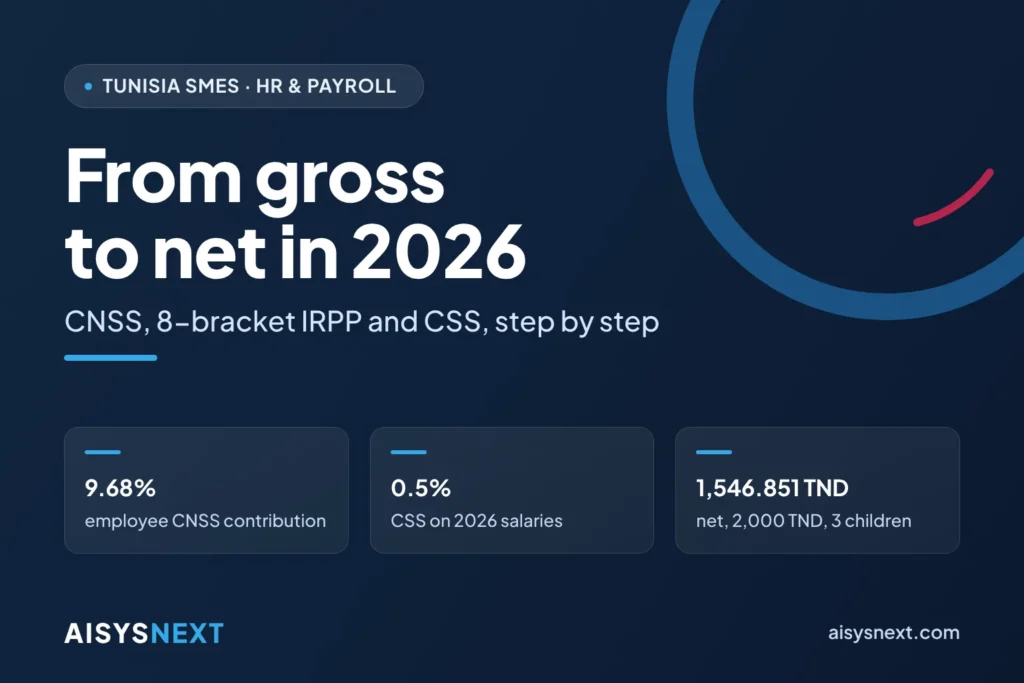
Short answer: In 2026, you move from gross to net pay by subtracting three deductions: the employee contribution to the CNSS (National Social Security Fund) at 9.68% of gross salary, personal income tax (IRPP) calculated on annual income with the eight-bracket scale, and the social solidarity contribution (CSS, 0.5%). Example: a head of household with three dependent children, paid 2,000 TND gross, receives 1,546.851 TND net per month.
Your payslips come out of an Excel file inherited from a former accountant. An employee compares theirs with that of a friend paid the same gross salary elsewhere: the two net amounts differ. A file still running on an old rate or an old scale produces a wrong net salary, every month, for every employee.
Key points
- Employee CNSS contribution: 9.68% of gross salary since January 1, 2025.
- Professional expenses: 10% of income after contributions, capped at 2,000 TND per year.
- Family deductions: 300 TND for the head of household, 100 TND per dependent child for the first four.
- IRPP scale: eight brackets, from 0% to 40%, in force since January 1, 2025 and unchanged in 2026.
- CSS: 0.5% on salaries paid from January 1 to December 31, 2026; back to 1% on January 1, 2027 absent any new provision.
Which deductions separate gross from net salary in 2026?
Three deductions separate gross from net: the employee CNSS contribution, IRPP and the CSS. You withhold them from the payslip, then pay them over.
- CNSS contribution: 9.68% of the entire salary, with no general ceiling. Article 17 of Law No. 2024-48 added a 0.5% contribution for the job loss insurance fund to the 9.18% base rate.
- IRPP: withholding tax calculated with the annual scale in Article 36 of Law No. 2024-48. This scale applies to salaries, bonuses and back pay received since January 1, 2025.
- CSS: 0.5% on salaries paid in 2026 (Law No. 2025-17, Article 87). Since its creation in 2018, it has been calculated on net taxable income; our sources do not confirm this base for 2026: our example uses it, so have your chartered accountant validate it. It exempts employees who receive only salaries, pensions or life annuities and whose annual net income does not exceed 5,000 TND.
These deductions do not tell you what the position costs you: employer charges come on top of gross salary. Our article on the real cost of an employee to the employer details them.
Which IRPP scale and deductions apply to salaries?
The scale has eight brackets and applies to net taxable income for the year, not to the monthly salary.
| Annual net taxable income | Rate |
|---|---|
| 0 to 5,000 TND | 0% |
| 5,000.001 to 10,000 TND | 15% |
| 10,000.001 to 20,000 TND | 25% |
| 20,000.001 to 30,000 TND | 30% |
| 30,000.001 to 40,000 TND | 33% |
| 40,000.001 to 50,000 TND | 36% |
| 50,000.001 to 70,000 TND | 38% |
| Above 70,000 TND | 40% |
Before applying the scale, subtract the following from annual salary, in this order:
- mandatory social security contributions;
- professional expenses: 10% of income after contributions, up to 2,000 TND per year (Article 26 of the Personal Income Tax and Corporate Tax Code);
- family deductions: 300 TND for the head of household, 100 TND per dependent child for the first four, 1,000 TND for a student child under 25 without a scholarship, 2,000 TND for a disabled child (2018 Finance Law, Articles 54 and 55).
Common note (note commune) No. 3/2025 from the DGI (tax administration) states that the new scale did not change any of these deductions.
How do you calculate net pay step by step? Example at 2,000 TND gross
Annualize the salary, calculate the tax for the year, then spread the withholding over the pay months. Example: a head of household with three dependent children, 2,000 TND gross over twelve months, with no bonus or benefit in kind.
| Step | Calculation | Amount |
|---|---|---|
| 1. CNSS contribution | 2,000 × 9.68% | 193.600 TND |
| 2. Monthly taxable salary | 2,000 − 193.600 | 1,806.400 TND |
| 3. Annual income after contributions | 1,806.400 × 12 | 21,676.800 TND |
| 4. Professional expenses | 10% = 2,167.680, capped | 2,000.000 TND |
| 5. Family deductions | 300 + 3 × 100 | 600.000 TND |
| 6. Net taxable income | 21,676.800 − 2,000 − 600 | 19,076.800 TND |
| 7. Annual IRPP | 5,000 × 15% + 9,076.800 × 25% | 3,019.200 TND |
| 8. Monthly IRPP | 3,019.200 / 12 | 251.600 TND |
| 9. Annual CSS (base to be confirmed) | 19,076.800 × 0.5% | 95.384 TND |
| 10. Monthly CSS | 95.384 / 12, rounded to the millime | 7.949 TND |
| 11. Monthly net pay | 2,000 − 193.600 − 251.600 − 7.949 | 1,546.851 TND |
Check: the deductions total 193.600 + 251.600 + 7.949 = 453.149 TND. Rounding the CSS withholds 4 millimes too much over twelve months (12 × 7.949 = 95.388 TND): correct them on the last payslip.
The professional expenses cap applies as soon as annual income after contributions exceeds 20,000 TND, or about 1,845 TND gross per month.
What errors do Excel payroll files contain?
Typical errors come from an outdated parameter or an overwritten formula. On our 2,000 TND example:
- Old CNSS rate of 9.18%. The file withholds 183.600 TND instead of 193.600 TND and pays out 7.450 TND too much in net salary every month.
- CSS still at 1%. The file withholds 190.768 TND over the year instead of 95.384 TND.
- Uncapped professional expenses. The formula deducts 2,167.680 TND instead of 2,000 TND and understates IRPP by 41.920 TND per year.
- Pre-2025 scale. A scale dating from before January 1, 2025 distorts the withholding, including on back pay for prior years.
- Incomplete annualization. The salary increases published on April 30, 2026 apply retroactively from January 1: back pay or a bonus left out of annual income distorts the tax.
- Frozen family status. A birth, a child who becomes a student or a fifth child (with no 100 TND deduction) changes the calculation.
- Single base. Article 22 of the 2026 Finance Law removes from the IRPP base, for all companies, home-to-work transportation provided to blue-collar workers; this benefit remains subject to social security contributions.
The stakes go beyond the gap in net pay: according to La Presse, an employer that fails to withhold the CSS faces a fine equal to the amount not withheld, doubled for a repeat offense within two years. Isolate rates, the scale and caps in a dated table, separate from the calculations, and review it every December and whenever a new text comes out.
How AISYSNEXT supports you
AISYSNEXT starts from your actual payslips and works alongside your chartered accountant, without replacing them.
- We audit your payroll file: we recalculate a sample of payslips and list the discrepancies in rates, caps and scales.
- We configure AROVA ERP (personnel records, leave, attendance, payroll items) with a dated parameter table.
- We develop useful customizations on a quote basis, for example consistency checks before payslips are issued.
- We migrate your data, train your team and help you move from Excel to an ERP, with support from Tunis.
Send us an anonymized payslip with your free quote request or contact our team.
Frequently asked questions
Why don’t two employees with the same gross salary get the same net pay?
Their family situations differ. At 2,000 TND gross, a single employee with no children receives 1,534.101 TND, compared with 1,546.851 TND for the head of household in our example: the 600 TND of deductions account for 12.750 TND of net pay per month.
Will the CSS stay at 0.5% in 2027?
Not as things stand. The extension that was voted covers only 2026: absent any new provision, the CSS returns to 1% on January 1, 2027. As of October 9, 2026, we know of no measure in the draft 2027 Finance Law, which is expected at the ARP (Parliament) by October 15, 2026 at the latest: plan for both rates in your table.
When do you pay over the IRPP and CSS withheld?
With the monthly tax return: by the 15th of the month at the latest for individuals, the 20th for companies registered for online filing and online payment, and the 28th for other companies. The CNSS contribution follows the quarterly salary declaration.
Sources
- DGI, common note No. 3/2025 — IRPP scale and professional expenses
- DGI, common note No. 7 — family deductions
- Jurisite Tunisie — 2025 Finance Law, Article 17
- PwC Tax Summaries — employee social security contributions
- PwC Tax Summaries — income tax, CSS exemption
- PwC Tax Summaries — CSS from 2027
- La Presse — CSS 2026, January 14, 2026
- Deloitte Société d’Avocats — 2026 Finance Law
Article up to date as of October 9, 2026. It provides information and does not replace the advice of your chartered accountant or legal counsel.