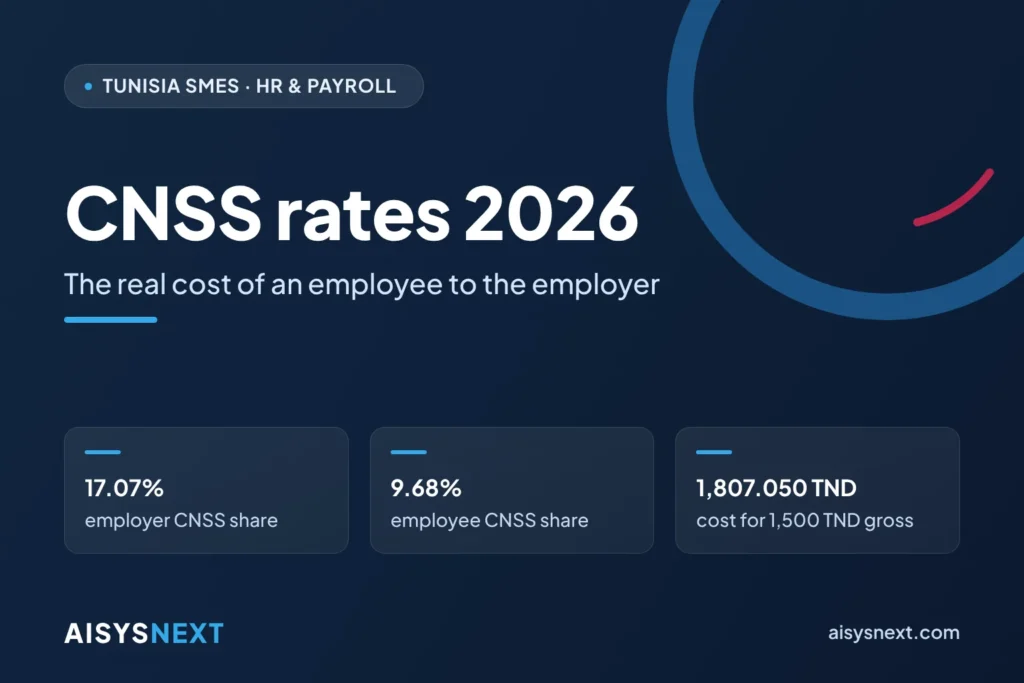
Short answer: In 2026, employers under the non-agricultural employee scheme pay the CNSS (National Social Security Fund) 17.07% of gross salary and withhold 9.68% from the employee’s pay. Add work accident insurance (0.4% to 4%), the vocational training tax (TFP, 2%, or 1% in manufacturing) and the FOPROLOS housing fund contribution (1%): an employee costs between 19.47% and 24.07% more than their gross salary. Example: a gross salary of 1,500 TND comes to 1,807.050 TND per month.
You hire a sales rep at 1,500 TND gross and put 18,000 TND in the annual budget. At the end of the quarter, the CNSS asks for more than you planned. Every month, the tax return adds two payroll taxes. On this one position alone, the gap reaches 3,684.600 TND over twelve months.
Key points
- CNSS, employer share: 17.07% of gross salary, made up of a 16.57% base rate and 0.5% for the job loss insurance fund, since January 1, 2025.
- CNSS, employee share: 9.68%, which you withhold from the salary and then pay over. Total paid to the CNSS: 26.75%.
- Work accidents: 0.4% to 4% depending on the business sector, paid by you alone.
- TFP and FOPROLOS: 2% (1% for manufacturing industries) and 1% of gross payroll, on the monthly tax return.
- Full cost: gross salary increased by 19.47% to 24.07%, excluding special schemes.
- Status as of October 9, 2026: our sources show no change to CNSS rates in 2026.
What are the CNSS rates in 2026 for employers and employees?
The employer rate is 17.07% and the employee rate is 9.68%, for a total of 26.75% of gross salary. The base rate (16.57% + 9.18%) has not changed since July 1, 2009. Article 17 of Law No. 2024-48 (2025 Finance Law) added 0.5% to it on January 1, 2025, payable by each party, for the insurance fund against job loss for economic reasons.
| Contribution | Employer share | Employee share | Legal basis or return |
|---|---|---|---|
| CNSS, base rate | 16.57% | 9.18% | Law No. 60-30 of December 14, 1960 |
| Job loss insurance fund | 0.5% | 0.5% | Law No. 2024-48, Article 17 |
| Total CNSS | 17.07% | 9.68% | Quarterly salary declaration |
| Work accidents and occupational diseases | 0.4% to 4% | None | Law No. 94-28, Decree No. 95-538 |
| TFP | 2% (1% manufacturing industries) | None | Monthly tax return |
| FOPROLOS | 1% | None | Monthly tax return |
| Total payable by you | 19.47% to 24.07% | Sum of the rows |
The contribution base covers the entire salary, with no general ceiling. Employers that belong to the supplementary pension scheme (CAVIS) add 6% on the employer side and 3% on the employee side on the portion of salary above 6 times the SMIG (guaranteed minimum wage).
The work accident rate depends on your sector and varies with your prevention measures (bonus-malus). We could not consult the rate schedule by activity code: have your rate confirmed by the CNAM (National Health Insurance Fund), which manages this scheme.
How much does an employee paid 1,500 TND or 2,500 TND gross cost?
A gross salary of 1,500 TND costs 1,807.050 TND per month with a work accident rate of 0.4%; a gross salary of 2,500 TND costs 3,076.750 TND in a manufacturing business at the 4% rate. These examples use the two ends of the legal range: replace them with your own rate.
| Line | Example 1: services, 1,500 TND gross | Example 2: manufacturing, 2,500 TND gross |
|---|---|---|
| Employer CNSS (17.07%) | 256.050 TND | 426.750 TND |
| Work accidents | 6.000 TND (0.4%) | 100.000 TND (4%) |
| TFP | 30.000 TND (2%) | 25.000 TND (1%) |
| FOPROLOS (1%) | 15.000 TND | 25.000 TND |
| Total employer charges | 307.050 TND (20.47%) | 576.750 TND (23.07%) |
| Full monthly cost | 1,807.050 TND | 3,076.750 TND |
| Cost over 12 months | 21,684.600 TND | 36,921.000 TND |
The employee share does not add to your cost, but it passes through your cash flow. In example 1, you withhold 145.200 TND per month from the payslip. Every quarter, you pay both shares to the CNSS: 4,500 × 26.75% = 1,203.750 TND, of which 768.150 TND is the employer share.
Which budgeting mistakes come up most often?
Most gaps come from a budget built on gross salary alone or on outdated rates.
- Budgeting gross salary without charges. You underestimate each position by 19.47% to 24.07%.
- Keeping pre-2025 rates. A file still set at 16.57% and 9.18% ignores the 0.5% added on each side.
- Forgetting the TFP and FOPROLOS. These taxes do not go through the CNSS: you pay them every month with the tax return.
- Copying another company’s work accident rate. The gap between 0.4% and 4% represents 3.6 points of payroll.
- Leaving out bonuses and benefits in kind. Charges apply to all compensation. A 3,000 TND bonus costs 614.100 TND in charges in example 1.
- Confusing expense and cash outflow. The CNSS collects quarterly: without a monthly provision, the due date catches your cash flow off guard.
- Ignoring relief measures. Article 13 of Law No. 2025-17 (2026 Finance Law) shifts to the State the employer contribution for higher-education graduates hired from January 1, 2026: 100% in the first year, then 80%, 60%, 40% and 20%. We found no text describing the application file to submit: ask your CNSS office.
How do you calculate your real employee cost, step by step?
Apply your rates to each position, then turn the result into cash-flow due dates.
- List the full compensation for each position: base salary, bonuses, allowances, benefits in kind.
- Set your four rates: CNSS 17.07%, work accidents, TFP at 2% or 1%, FOPROLOS at 1%.
- Calculate the monthly and annual cost of each position, then of the whole workforce.
- Schedule the cash outflows. CNSS: January 15, April 15, July 15 and October 15. TFP and FOPROLOS: every month, on the 15th for individuals, the 20th for companies that file online, the 28th for the others.
- Set aside a provision every month. Late payment costs 1% of contributions per month or part of a month, and an additional 0.5% per month if you have not filed the salary declaration either (Article 105 of Law No. 60-30).
- Keep a dated rate table, separate from the calculations, and review it every December.
October 15, 2026 falls on a public holiday. We have seen no notice of postponement: file without counting on one.
How AISYSNEXT supports you
AISYSNEXT starts from your actual payroll and works alongside your chartered accountant, without replacing them.
- We audit your payroll files (rates, contribution bases, due dates) and assess with you whether it is time to move from Excel to an ERP.
- We configure AROVA ERP (personnel records, attendance, payroll items, dashboards) with a dated rate table.
- We develop useful customizations on a quote basis, for example a full-cost report per position, as part of an ERP and CRM integration.
- We migrate your data, train your team and provide support from Tunis.
Describe your workforce in a free quote request or contact our team.
Frequently asked questions
Will CNSS rates change in 2027?
As of October 9, 2026, we know of no measure on contributions in the draft 2027 Finance Law. The bill must reach the ARP (Parliament) by October 15, 2026 at the latest: follow its content, then the final text, before you lock in your budget.
What is the 0.5% job loss fund contribution for?
It finances an insurance fund against job loss for economic reasons. You have paid it since January 1, 2025, but we could confirm neither the decree governing the fund nor the payment of any benefits.
Does a fully exporting company pay the same rate?
Deloitte and PwC cite a reference employer rate of 16.57% instead of 17.07% for these companies. PwC refers only to industrial exporters: have the CNSS confirm the scope.
Sources
- CNAM — work accidents and occupational diseases
- Ministry of Finance — overview of taxation (TFP, FOPROLOS)
- Jurisite Tunisie — 2025 Finance Law, Article 17 (job loss fund)
- Jurisite Tunisie — Law No. 60-30, declaration and penalties
- CLEISS — contributions in Tunisia
- PwC Tax Summaries — overall social security rates
- PwC Tax Summaries — payroll taxes
- Deloitte Société d’Avocats — 2026 Finance Law
Article up to date as of October 9, 2026. It provides information and does not replace the advice of your chartered accountant or legal counsel.