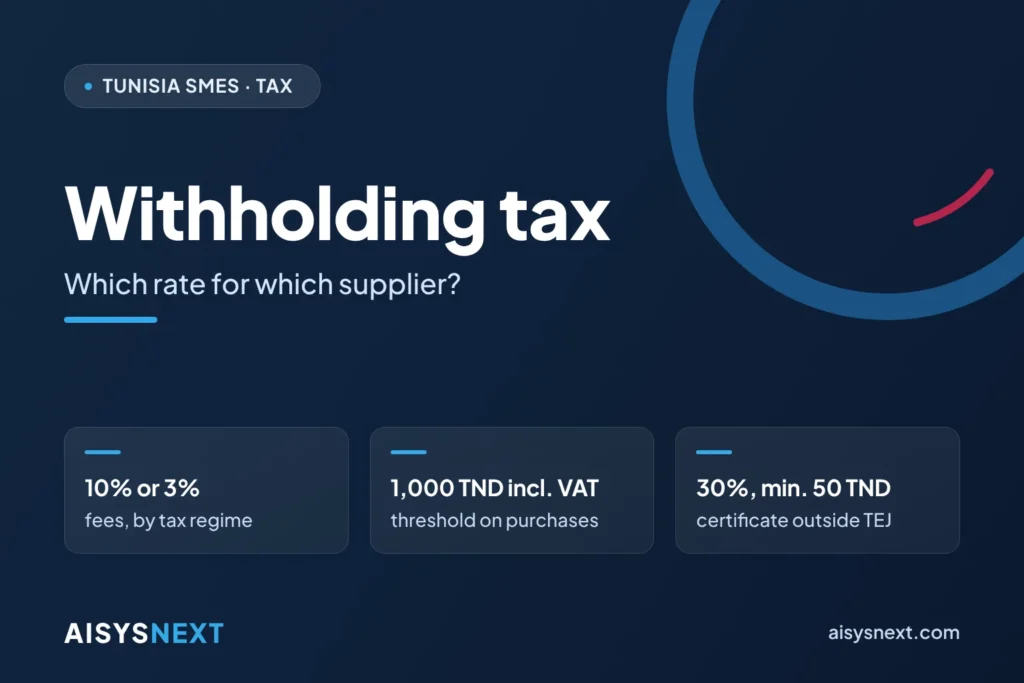
Short answer: You withhold 10% on fees, commissions, brokerage fees and rent, but 3% on fees paid to a company subject to corporate income tax (IS) or to an individual under the actual-basis regime. On purchases of 1,000 TND or more including VAT, the rate ranges from 0.5% to 1.5% depending on the supplier; have your chartered accountant validate this breakdown. You then create the certificate on TEJ (the online tax data exchange platform) before the end of the month following the payment.
Your accountant pays the fees of a consulting firm, a company subject to IS, withholds 10% out of habit and hands over a paper certificate. Two mistakes in one payment: this supplier falls under the 3% rate, and a certificate issued outside the platform costs a fine.
Key points
- 10%: fees, commissions, brokerage fees, rent and payments for non-commercial activities.
- 3%: fees paid to legal entities subject to IS and to individuals under the actual-basis regime.
- 1.5%, 1% or 0.5%: purchases of goods, equipment and services of 1,000 TND or more including VAT; breakdown to be validated.
- Certificate: on TEJ, no later than the end of the month following the payment.
- Certificate issued outside the platform: fine of 30% of the withholding, with a minimum of 50 TND per certificate.
- Insufficient withholding: penalty equal to the amount not withheld (Article 83 of the Code of Tax Rights and Procedures, CDPF).
Which withholding tax rate applies to which supplier?
The rate depends first on the type of payment, then on the supplier’s tax regime. Article 52 of the Personal Income Tax and Corporate Tax Code sets these rates; Article 14 of Law No. 2020-46 lowered the rates on fees from 15% to 10% and from 5% to 3% as of 2021.
| Payment and supplier | Rate | Reliability |
|---|---|---|
| Fees paid to a legal entity subject to IS or to an individual under the actual-basis regime | 3% | Confirmed |
| Fees outside the case above; commissions, brokerage fees, rent, payments for non-commercial activities | 10% | Confirmed |
| Purchases of goods, equipment and services of 1,000 TND or more including VAT, general case | 1.5% | To be validated |
| Same purchases, supplier is a company subject to the standard IS rate | 1% | To be validated |
| Same purchases, supplier taxed at 10% | 0.5% | To be validated |
| Interest (investment income) and directors’ fees | 20% | Confirmed |
| Dividends paid to resident individuals and to non-residents | 10% | Confirmed |
| Payments to non-residents | 15% (25% to low-tax jurisdictions) | Confirmed |
| Sale of real estate by an individual | 2.5% of the price | Confirmed |
Point to validate: the three rates on purchases come from Article 52-I-g of the code, as summarized by PwC and Finco. Their exact breakdown after the standard IS rate moved to 20% remains to be checked in the 2026 Code: have your chartered accountant confirm the rate for each supplier.
From what amount do you withhold, and on which payments do you withhold nothing?
Withholding on purchases of goods, equipment and services applies from 1,000 TND including VAT. Assess this threshold with all taxes included: an invoice below 1,000 TND excluding tax can reach the threshold once VAT is added. Our sources provide for this threshold only for purchases: do not apply it to fees or rent.
You withhold nothing on telephone, water, electricity, gas and newspaper subscriptions, or on insurance and leasing contracts (Article 52 of the same code).
If you sell to the State, local authorities or public enterprises, Finco also reports a 25% VAT withholding from 1,000 TND (Articles 19 and 19 bis of the VAT Code). Only one source mentions it: check this point.
When and how do you issue the withholding certificate on TEJ?
You create the certificate on TEJ no later than the end of the month following the month of payment: a July payment requires a certificate before August 31. The order of the Minister of Finance of May 10, 2024 sets this deadline.
The obligation has applied to all taxpayers since January 1, 2026. It rests on Article 55 of the Personal Income Tax and Corporate Tax Code, as amended by Article 41 of the 2022 Finance Law.
You enter the certificate manually or upload an XML file that complies with the specifications; the supplier finds it in their own account. Our complete guide to the TEJ application describes the procedure step by step.
You declare and pay the withholding itself with the monthly tax return, on the 15th, 20th or 28th depending on your status: our tax and social calendar through March 2027 lists these dates.
Which mistakes cost a fine?
Three penalties target the payer: for missing withholding, for a certificate issued outside the platform and for late filing.
- Withholding not made or insufficient: penalty equal to the amount not withheld, doubled for a repeat offense within two years (Article 83 of the CDPF, read in an older version of the code: to be confirmed).
- Certificate issued outside TEJ: fine of 30% of the withholding amount, with a minimum of 50 TND per certificate.
- Late monthly tax return: 1.25% of the tax per month or part of a month, plus 3% up to 60 days late and 5% beyond that (Article 81 of the CDPF).
Example: you pay 5,000 TND in fees subject to withholding to a provider that falls under the 10% rate, and you withhold 3%. Withholding due: 5,000 × 10% = 500 TND. Withholding made: 5,000 × 3% = 150 TND. The 350 TND shortfall costs you a 350 TND penalty. If you also hand over a paper certificate, 150 × 30% = 45 TND: the 50 TND minimum applies.
The most common mistakes
- applying 10% to all fees without checking the supplier’s regime;
- assessing the 1,000 TND threshold excluding tax instead of including VAT;
- withholding on an electricity, telephone, insurance or leasing invoice;
- handing over a paper certificate, or creating the certificate after the end of the following month;
- failing to request certificates from your own clients, even though you need them to offset the withholding you have borne.
Which monthly control should you put in place?
A five-point check, dated and signed, closes each month.
- Supplier record. Enter the tax regime and the rate; your accountant validates the record before the first payment.
- Calculation at payment. Calculate the withholding when you enter the payment, not at month-end.
- Reconciliation. Before the end of the month, check that each payment of the previous month subject to withholding has a recorded withholding and a certificate issued on TEJ.
- Tax return. Compare the total of certified withholdings with the amount reported in the monthly tax return.
- Withholding borne. Tick off the certificates received in your TEJ account and follow up with clients who have issued nothing.
How AISYSNEXT supports you
AISYSNEXT starts from your supplier payment process and works alongside your chartered accountant, without replacing them.
- We audit your supplier records and your payment process.
- We configure AROVA ERP (purchasing and suppliers, invoicing and accounting) to hold the tax regime and withholding rate on each supplier record.
- We study with you how to connect your management system to TEJ, in particular producing the XML file, and develop it on a quote basis.
- We train your accountants and provide support from Tunis.
Describe your organization to us in a free quote request or contact our team.
Frequently asked questions
My client withheld tax without issuing a certificate: can I offset the withholding?
No. Only withholdings covered by a certificate issued on the platform can be offset against your tax. Follow up with your client.
Can you correct an incorrect certificate?
Yes. The platform lets you modify or cancel a certificate. Correct it as soon as you notice the error, then align your monthly tax return.
Why does TEJ reject the XML file from my software?
The technical specifications change over time: the September 2026 version replaces the previous ones, with a new XSD schema to download. Ask your software vendor to update the export; Babnet also mentions a remote tax guidance center at 81 100 400.
Sources
- JIBAYA (DGI portal) — TEJ platform, deadline and fine
- Jurisite Tunisie — Personal Income Tax and Corporate Tax Code, Article 52
- Jurisite Tunisie — CDPF, Article 83
- PwC — withholding taxes in Tunisia
- CHA Expert — withholding rates since 2021
- Finco — withholding tax in 2026
- Babnet — what’s new in TEJ, September 8, 2026
- La Tribune — late filing penalties
Article up to date as of October 9, 2026. It provides information and does not replace the advice of your chartered accountant or legal counsel.