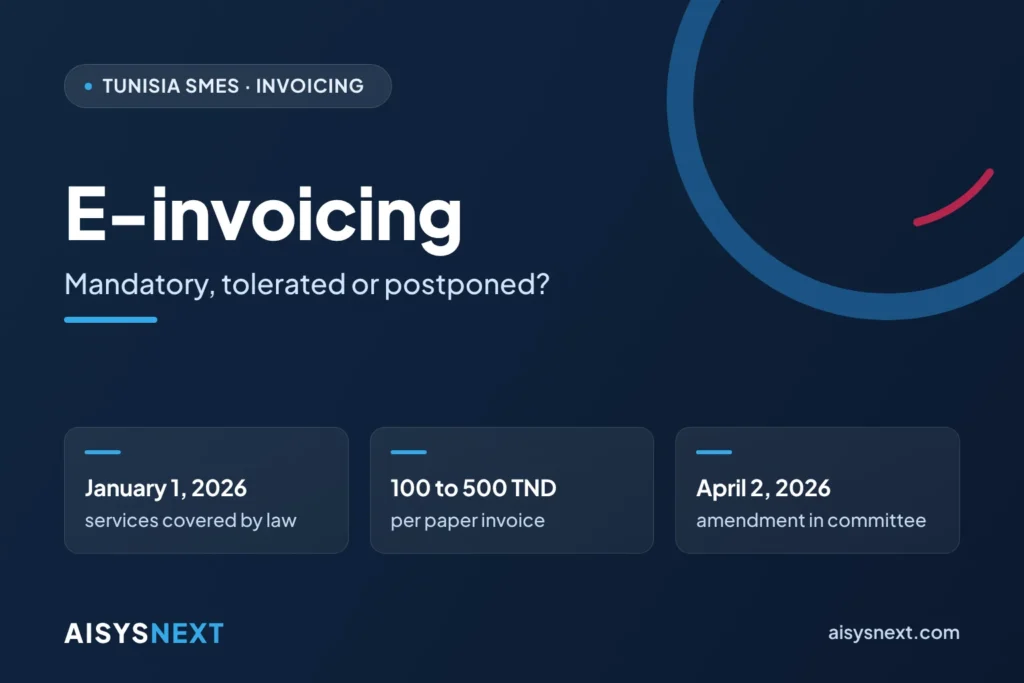
Short answer: As of October 9, 2026, e-invoicing applies, with no announced tolerance, to the “historic” obligated parties: companies that report to the DGE (Large Enterprises Directorate) for their transactions with the public sector, and business-to-business sales of medicines and fuels. For services, Article 53 of the 2026 Finance Law remains in the law, but common note (note commune) No. 02/2026 lets providers that have filed their enrollment application with Tunisie TradeNet (TTN) invoice on paper. To our knowledge, the postponement voted in committee on April 2, 2026 has cleared neither the plenary session nor the JORT (Official Gazette).
Your chartered accountant tells you the obligation has existed since January. A peer claims that “everything is postponed.” A software vendor is pressing you to sign. You run a services company: do your paper invoices remain valid, and what should you do this week?
Key points
- January 1, 2026: Article 53 of Law No. 2025-17 of December 12, 2025 extends e-invoicing to services.
- January 23, 2026: common note No. 02/2026 allows paper invoices for providers that have filed their TTN enrollment application.
- April 2, 2026: the finance committee of the ARP (Parliament) adopts an amendment that defers the application of Article 53; no source confirms what happened next.
- 100 to 500 TND per paper invoice, up to a limit of 50,000 TND: the penalty has existed since July 1, 2025.
- No official deadline closes the transition period.
Is e-invoicing mandatory, tolerated or postponed?
All three words are accurate, but not for the same companies. The law targets three categories; the administration has announced a tolerance for the third; Parliament has not completed the postponement it started.
| Your situation | Status as of October 9, 2026 | Penalties |
|---|---|---|
| Company reporting to the DGE, for its transactions with the State, local authorities, and public institutions and enterprises | Mandatory since the 2016 Finance Law | Applicable since July 1, 2025, with no announced tolerance |
| Sale of medicines or fuels between businesses, excluding retailers | Mandatory since the 2019 Finance Law | Same penalties, with no announced tolerance |
| Service provider | Mandatory in the law since January 1, 2026; paper accepted once the enrollment application is filed | Tolerance announced, with no legislative basis |
| Sale of goods outside these cases | Optional | Not applicable |
What does common note No. 02/2026 say?
Common note No. 02/2026 of January 23, 2026 sets up a transition period: it applies e-invoicing to providers already enrolled with TTN and lets the others invoice on paper if they have filed their enrollment application. The administration published it in Arabic only; we cite it on the basis of summaries from firms and the press.
- Criterion: you declared a service activity, main or secondary, in your business start-up declaration (déclaration d’existence).
- Non-commercial professions: the note includes them and treats their fee notes as invoices.
- Ancillary services: transport or installation tied to a sale does not trigger the obligation, unless you declared it as a secondary activity.
- Excluded documents: contracts, debit or credit notes and account statements that serve as an invoice.
- Deduction on the customer’s side: the customer keeps the deduction of VAT, expenses and depreciation if it holds a paper invoice that complies with Article 18 of the VAT Code.
This reading remains contested: the Tunisian Union of Liberal Professions and the Order of Physicians reject the extension to non-commercial professions, and the president of the Order of Chartered Accountants of Tunisia (OECT) argued before the ARP that an administrative note cannot replace the law.
Where does the postponement voted in Parliament stand?
The postponement remains unfinished: the finance committee voted for it on April 2, 2026, but no source we consulted confirms its adoption in plenary session or its publication in the JORT.
- February 10, 2026: before the ARP, the Ministry of Finance states that it will not apply penalties as long as the platform is not fully ready. TTN states that fewer than 3% of the companies concerned have enrolled.
- April 2, 2026: the committee rejects the repeal of Article 53 and the postponement of the penalties to January 1, 2027. It adopts an amendment to Article 110 of the 2026 Finance Law: a later legislative text will set the date on which Article 53 takes effect.
- September 29, 2026: a member of Parliament who sits on the committee states that the matter remains under discussion.
One press source mentions a postponement limited to the penalties; the most detailed reports describe a postponement of the application of Article 53 itself. A tax adviser anticipates a phased rollout, from large companies first to small providers in 2028: no text sets this timetable, nor the January 1, 2027 date that is sometimes cited.
What to watch: the review of the draft 2027 Finance Law at the ARP, expected between mid-October and mid-December 2026 (timetable to be confirmed). As of October 9, 2026, the text of the draft is not public.
Which mistakes should you avoid during the transition period?
The costliest mistake is to confuse tolerance with postponement: the tolerance rests on statements by the administration and on the common note, not on a law.
- Filing nothing. The common note covers the provider that has filed its enrollment application, not the one that waits.
- Underestimating the fine. Article 94 of the Code of Tax Rights and Procedures (CDPF) provides for 100 to 500 TND per paper invoice issued in place of a mandatory electronic invoice, up to a limit of 50,000 TND. Example: 60 invoices represent at least 6,000 TND (60 × 100 TND) and at most 30,000 TND (60 × 500 TND). Sources disagree on whether the cap applies per audit or per fiscal year.
- Letting an old paper file sit idle. Since September 15, 2026, TTN has been asking companies whose paper file it has not yet validated to re-register online.
What should you do now, without waiting for Parliament?
File your enrollment application and prepare your data: both actions remain useful whatever the timetable. Our guide to the e-invoicing procedure details each formality.
- Check your business start-up declaration. A service activity, even a secondary one, places you within the scope of the common note.
- File the application on adhesion.elfatoora.tn. Keep the electronic acknowledgment of receipt and the reference number.
- Choose your mode. The El Fatoora e-invoicing portal (portail.elfatoora.tn), opened on September 15, 2026, suits low volumes with no specific integration solution. EDI mode links your management software to TTN for high volumes.
- Estimate the cost. Before the ARP, TTN cited 190 millimes per invoice and about 10 TND for the monthly subscription. Example: 200 invoices per month cost 38 TND (200 × 0.190 TND), or about 48 TND with the subscription. We did not find the pricing order: confirm these amounts with TTN.
- Clean up your files. Customer tax IDs (matricules fiscaux), duplicates, continuous numbering, VAT rates: correct them before any connection.
- Review the situation again with your chartered accountant as soon as the draft 2027 Finance Law is published.
How AISYSNEXT supports you
AISYSNEXT helps SMEs turn this uncertainty into an action plan, alongside their chartered accountant.
- We audit your invoicing workflow and your customer files, then we define the mode suited to your volume.
- We configure invoicing in AROVA ERP: templates, numbering, customer records.
- We study with you how to connect your management system to El Fatoora and we develop that connection based on a quote, as part of our ERP and CRM integration offering.
- We train your teams and provide support from Tunis.
Tell us about your situation: request a free quote or contact our team.
Frequently asked questions
Is e-invoicing postponed to 2027?
No. To our knowledge, no published text provides for it. The amendment voted in committee on April 2, 2026 refers the date to a later text, with no confirmed plenary vote. The January 1, 2027 date circulates with no official basis.
Can my customer deduct the VAT on my paper invoice?
Yes, according to common note No. 02/2026. The customer keeps the deduction of VAT and expenses if it holds a paper invoice that complies with Article 18 of the VAT Code.
I sell goods: am I affected?
No, apart from three cases: medicines or fuels sold to businesses, sales by a company reporting to the DGE to the public sector, a declared secondary service activity. Otherwise, e-invoicing remains optional.
Sources
- JIBAYA portal — common note No. 02/2026
- ARP — hearing of February 10, 2026
- JIBAYA portal — notice to the taxpayers concerned
- Jurisite Tunisie — 2025 Finance Law, Article 71
- Chaexpert — common note No. 02/2026
- La Presse — decision of the finance committee
- La Presse — draft 2027 Finance Law
- L’Économiste Maghrébin — El Fatoora portal
Article up to date as of October 9, 2026. It provides information and does not replace the advice of your chartered accountant or legal counsel.