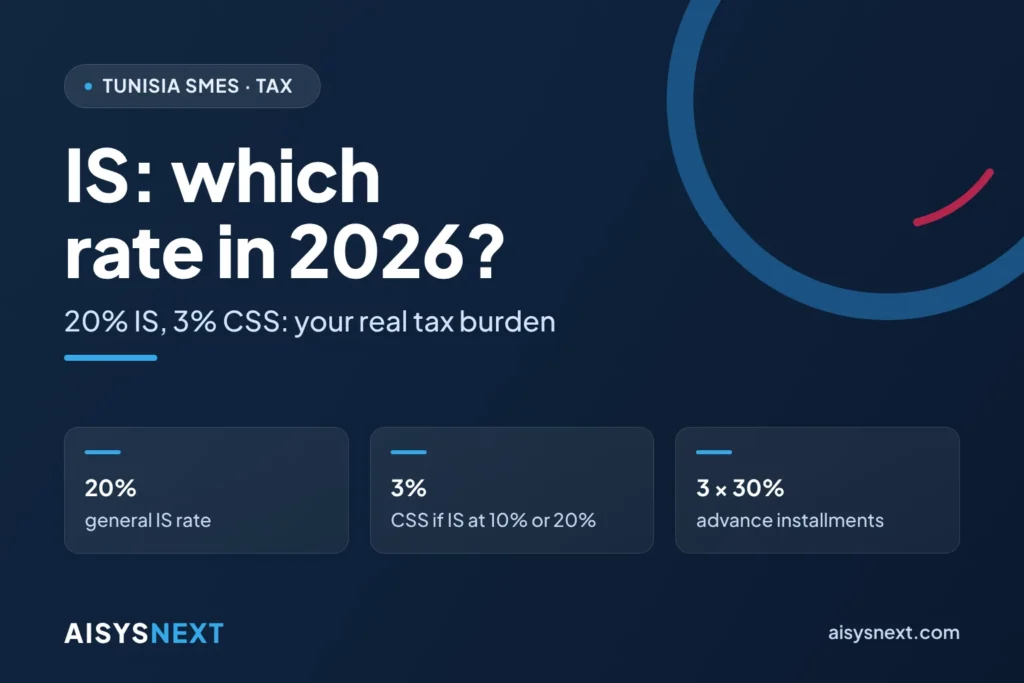
Short answer: In 2026, the general corporate income tax (IS) rate in Tunisia stands at 20%. The 10%, 35% and 40% rates target specific activities, and the 25% rate does not exist under current law. Add the social solidarity contribution (CSS): 3% on profits declared in 2026 by a company taxed at 20%.
Your spreadsheet applies 25% to profit because an online guide says so. Your business partner uses 20% and forgets the CSS. Both calculations are wrong, and the gap reaches several thousand dinars once profit hits 150,000 TND.
Key points
- General rate: 20%, up from 15% previously (Article 37 of Law No. 2024-48 of December 9, 2024).
- Other rates: 10%, 35% or 40% depending on the activity; there is no 25% rate.
- CSS, profits declared in 2026: 3% for IS at 10% or 20%, 4% for IS at 35% or 40%.
- Minimum tax: 0.2% of gross local revenue, with a floor of 500 TND, due even when the company posts a loss.
- Deadlines: return on March 25; 30% installments on June 28, September 28 and December 28 (date to be confirmed for online filing).
Which corporate income tax rate applies to your company in 2026?
A standard SME pays 20%: Article 37 of Law No. 2024-48 amended Article 49 of the Personal Income Tax and Corporate Tax Code and raised the general rate from 15% to 20%. The other rates depend on the activity, not on company size.
| IS rate | Activities concerned | CSS, profits declared in 2026 |
|---|---|---|
| 10% | Crafts, agriculture and fishing, service and consumer cooperatives, projects under youth employment programs, pollution control, regional development zones after the full-deduction period | 3%, minimum 200 TND |
| 20% | General rate | 3%, minimum 400 TND |
| 35% | Payment institutions, SICAFs and SICARs (investment companies), debt collection companies, telecom operators, hydrocarbon-related services, refining and wholesale of petroleum products, hypermarkets (over 3,000 m² of built area or over 1,500 m² of sales area), car dealers, franchisees of foreign brands (unless the local integration rate is 30% or more) | 4%, minimum 500 TND |
| 40% | Banks and financial institutions (excluding payment institutions), insurance and reinsurance, mutual insurers, takaful | 4%, minimum 500 TND |
Two sources link the 20% rate to profits earned since January 1, 2024 and declared from 2025 onward; we have not cross-checked this date against the Official Gazette.
Why does the 25% rate not exist under current law?
The adopted text did not keep it. The draft 2025 Finance Law proposed three rates based on revenue: 15% below 5 million dinars, 20% from 5 to 20 million, and 25% from 20 million upward. The law as passed sets a single general rate of 20%.
Three factors keep the confusion alive:
- articles from October 2024 describe the draft, not the law;
- the Ministry of Finance page “Tunisian tax system” (Système fiscal tunisien) still showed a general rate of 25% on October 9, 2026: it is out of date;
- the 2% temporary (conjoncturelle) contribution (Article 38 of Law No. 2024-48) did depend on revenue, but it applied only to 2025 and to companies with revenue of 20 million dinars or more, excluding taxes, in 2023.
CSS and minimum tax: what do you pay on top of IS?
You pay the CSS on top of IS, plus a minimum tax if profit is low or zero.
The CSS. For profits declared in 2026 (fiscal year 2025), Article 87 of Law No. 2025-17 sets the CSS at 3% for a company taxed at 20%, with a minimum of 400 TND. Exempt companies and companies under full deduction pay a flat 400 TND. Our sources do not detail the CSS base: the example below applies it to taxable profit, a choice to confirm with your chartered accountant.
These increased rates cover returns due from 2023 to 2026. Without a further extension, the CSS returns to 1% from January 1, 2027. As of October 9, 2026, we found no published text of the draft 2027 Finance Law.
The minimum tax. It amounts to 0.2% of gross local revenue, with a floor of 500 TND for legal entities (common note (note commune) No. 1/2015). Companies taxed at 10% fall under a 0.1% rate, with a floor of 300 TND.
- You owe it even when the company posts a loss.
- Since fiscal year 2014, you can no longer offset it against the tax of subsequent years (Article 22 of Law No. 2014-59).
- If you pay it more than one month after the deadline, the floor rises by 50%: 750 TND instead of 500 TND.
Advance tax installments and the annual return: which dates should you remember?
From its second year of activity, the company pays three installments, each equal to 30% of the IS due for the previous year (Article 51 of the Personal Income Tax and Corporate Tax Code). For a fiscal year aligned with the calendar year:
| Deadline | Obligation |
|---|---|
| March 25 | Annual IS return |
| April 30 | Annual employer return |
| June 25 | Final return for companies subject to a statutory audit |
| June 28 | First installment |
| September 28 | Second installment |
| December 28 | Third installment |
Installments and withholding tax deducted from your receipts are offset against the final IS. Add these dates to your tax and payroll calendar.
Point to check: the DGI (tax administration) has reminded taxpayers that September 28, 2026 is the deadline for the second installment of legal entities, the only confirmed date. If your company uses online filing, ask your chartered accountant whether your installments fall on the 28th or the 20th.
How much does a standard SME pay, and how do you build it into your forecast?
On profits declared in 2026, a company taxed at 20% spends 23% of its taxable profit on IS and CSS. Example: a trading SARL (limited liability company) closes 2025 with gross local revenue of 1,200,000 TND and taxable profit of 150,000 TND.
- IS: 150,000 × 20% = 30,000 TND.
- Minimum tax: 1,200,000 × 0.2% = 2,400 TND, lower than the IS: the company pays 30,000 TND.
- CSS: 150,000 × 3% = 4,500 TND.
- Total burden: 34,500 TND, or 23% of profit.
- 2026 installments: 30,000 × 30% = 9,000 TND per deadline, or 27,000 TND in total.
A forecast at 25% sets aside 37,500 TND, which is 3,000 TND too much. A forecast at 20% without the CSS stops at 30,000 TND: it falls 4,500 TND short. If the same company posts a loss, it still owes 2,400 TND of minimum tax; ask your chartered accountant whether the 400 TND CSS minimum also applies in that case, because our sources do not say.
The five-step method
- Set your rate based on your activity and a dated text.
- Separate IS and CSS. For 2027, model two CSS scenarios: 1% without an extension (1,500 TND in the example), 3% if an extension renews the current rate (4,500 TND).
- Compare IS with the minimum tax. Use the higher amount.
- Schedule each payment in the right month. IS balance and CSS with the March return, installments in June, September and December, calculated on the previous year’s IS. If the company in the example earns the same profit in 2026, the March 2027 balance comes to 30,000 − 27,000 = 3,000 TND.
- Track the withholding tax deducted from your receipts. It reduces the balance only if your clients have issued the withholding tax certificates: follow up with them.
How AISYSNEXT supports you
Your chartered accountant sets the rate and validates the return; AISYSNEXT works alongside them to organize the data that feeds the calculation.
- We audit your monthly close and the way you build your forecast.
- We configure AROVA ERP (invoicing and accounting, dashboards) to track your results month by month.
- We develop useful customizations on quote, such as a tax payment schedule or a simulation of IS, CSS and installments.
- We train your teams and provide support from Tunis.
Describe your organization in a free quote request or contact our team.
Frequently asked questions
Does the IS rate depend on revenue?
No. The rate depends on the activity. The revenue-based bracket scale appeared in the draft 2025 Finance Law, not in the adopted text.
Does a loss-making company still pay tax?
Yes. It owes the minimum tax of 0.2% of gross local revenue, with a floor of 500 TND, with no carryforward to subsequent years.
Will the corporate CSS go down in 2027?
Without a further extension, it returns to 1% from January 1, 2027. As of October 9, 2026, no published text settles the question: budget for both scenarios.
Sources
- Ministry of Finance — overview of taxation (IS rate out of date)
- Note commune No. 1/2015 — minimum tax
- Note commune No. 5/2025 — temporary contribution
- Jurisite Tunisie — Article 37 of Law No. 2024-48
- PwC — corporate income tax rates
- PwC — installments and returns
- InFirst — 2026 Finance Law, CSS
- WMC — draft 2025 Finance Law
Article up to date as of October 9, 2026. It provides information and does not replace the advice of your chartered accountant or legal counsel.