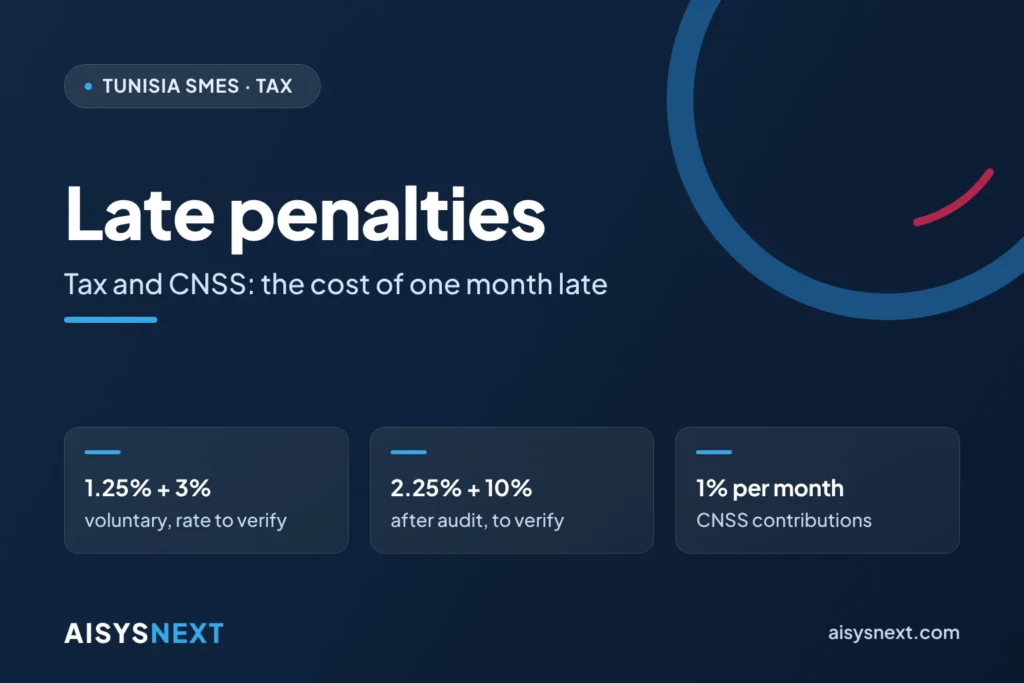
Short answer: For a tax return you regularize voluntarily, one month of delay costs 4.25% of the tax due: a 1.25% monthly penalty and a 3% fixed penalty, according to the rates published in late 2022, to be confirmed against the current code. If a tax audit detects the delay before you do, expect 12.25%, or even 22.25%. At the CNSS (National Social Security Fund), one month of delay costs 1% of contributions, and 1.5% if you have not declared the salaries.
The closing dragged on, and the monthly tax return goes out ten days late. The accountant mentions “a small penalty” that nobody quantifies. Yet the real cost depends on three factors: the agency, the length of the delay and, above all, who spots it first, you or the administration.
Key points
- Taxes, voluntary regularization: 1.25% per month or fraction of a month, plus 3% for a delay of up to 60 days, 5% beyond that (Article 81 of the CDPF, rates to be confirmed).
- Taxes, after a tax audit steps in: 2.25% per month, plus 10%, or even 20% in several cases (Article 82 of the CDPF, rates to be confirmed).
- CNSS: 1% per month or fraction of a month, plus 0.5% if you have not declared the salaries (Article 105 of Law No. 60-30).
- Withholding tax not deducted: a penalty equal to the amount not withheld (Article 83 of the CDPF, read in an old version of the code).
- One day late counts as a full month: the texts reason in months or fractions of a month.
How much does one month of delay on a tax return cost?
For 10,000 TND of tax, one month of delay costs 425 TND if you regularize on your own. The monthly tax return groups withholding tax, VAT, the TCL (local business tax), FOPROLOS (housing fund contribution) and the vocational training tax (TFP). You file and pay it at the same time: within the first 15 days of the month for individuals, the first 20 days for legal entities enrolled in online filing, and the first 28 days for the others.
Article 81 of the CDPF (Code of Tax Rights and Procedures), as amended by Article 59 of Decree-Law No. 2022-79, combines two penalties:
- 1.25% of the tax per month or fraction of a month of delay, compared with 0.75% before 2023;
- a fixed penalty of 3% if the delay does not exceed 60 days, and 5% beyond that, compared with 1.25% and 2.5% before 2023.
Example, for 10,000 TND of tax:
- ten days late: 125 TND (1.25%) + 300 TND (3%) = 425 TND;
- three months late: 375 TND (3 × 1.25%) + 500 TND (5%) = 875 TND.
These rates come from the business press that commented on the 2023 Finance Law; we have not reread the consolidated CDPF. Have your chartered accountant confirm them before any regularization.
Voluntary regularization or after an audit: what is the difference?
The same month of delay costs nearly three times more when a tax audit detects it before you do. Article 82 of the CDPF then raises the penalty to 2.25% per month, compared with 1.25% before 2023, and adds a fixed penalty of 10%. This fixed penalty rises to 20% for undeclared VAT and duties, ex officio assessment, understatement of the tax base and fraud.
Comparison for 10,000 TND due, in tax or contributions (tax rates subject to the same caveat):
| Situation | Monthly penalty | Fixed penalty | 1 month late | 3 months late |
|---|---|---|---|---|
| Tax, voluntary regularization | 1.25% | 3% up to 60 days, 5% beyond | 425 TND | 875 TND |
| Tax, after an audit | 2.25% | 10% | 1,225 TND | 1,675 TND |
| Tax, after an audit, 20% cases | 2.25% | 20% | 2,225 TND | 2,675 TND |
| CNSS, salaries declared | 1% | — | 100 TND | 300 TND |
| CNSS, salaries not declared | 1% + 0.5% | — | 150 TND | 450 TND |
Do not wait for a letter: a preliminary review (vérification préliminaire) takes place without prior notice, in the administration’s offices, based on your returns and documents.
How much does a late declaration or payment cost at the CNSS?
At the CNSS, each month of delay, even a partial month, costs 1% of the contributions not paid by the deadline. Article 105 of Law No. 60-30 adds 0.5%, calculated on the contributions due, when the employer has not declared the salaries.
Example: for a quarterly payroll of 60,000 TND, contributions at the overall rate of 26.75% reach 16,050 TND. One month of late payment costs 16,050 × 1% = 160.500 TND. With neither declaration nor payment, expect 16,050 × 1.5% = 240.750 TND per month or part of a month.
The CNSS then sends a formal notice by registered letter. Without regularization within 15 days, it issues an ex officio assessment. Our article on the CNSS quarterly declaration describes the filing routine.
What other sanctions add to the bill?
Three sanctions come on top of late-payment penalties.
- Forgotten withholding tax. Article 83 of the CDPF provides for a penalty equal to the amount of withholding not made or insufficient, doubled for a repeat offense within two years. A 1,500 TND withholding not deducted therefore costs 1,500 TND, then 3,000 TND for a repeat offense. We read this rule in an old version of the code: have it confirmed. Also check which withholding rate to apply to each supplier.
- Filing outside the online system. A return filed without the mandatory electronic means costs 0.1% of the principal tax amount, with a minimum of 200 TND and a maximum of 2,000 TND. The online filing guide published on jibaya.tn cites Article 81 bis of the CDPF; we have not verified this number.
- Late e-payment. According to this 2023 guide, the server remains unavailable between 5 p.m. and 7 p.m., and a payment made after 5 p.m. on the due date triggers penalties.
How can you organize yourself to stop paying penalties?
You need a calendar, a person in charge and a safety margin.
- Keep a single calendar. Enter your monthly tax dates (the 15th, 20th or 28th depending on your category) and the CNSS deadlines of January 15, April 15, July 15 and October 15. Our tax and social security calendar for SMEs provides the framework.
- Appoint a person in charge. Set them an internal deadline at D-3 for the monthly tax return, and alerts at D-10 and D-3 for the CNSS.
- Close early. Close the month’s journals before the 10th and file the CNSS declaration before the 10th of the month it falls due.
- Pay before 5 p.m. and check that your TunTrust electronic certificate is still valid.
- Set funds aside. Include the tax and social security payment schedule in your cash flow dashboard.
- If you are late, act first. Regularize your taxes before any tax audit steps in; for a CNSS debt, ask your regional office for a payment schedule.
How AISYSNEXT supports you
AISYSNEXT treats lateness as an organizational problem, working alongside your chartered accountant without replacing them.
- We audit your closing workflow: who enters data, who checks, who files, and on what date.
- We configure AROVA ERP (purchasing, invoicing and accounting, payroll items) so that your figures come from a single database, with a dashboard of deadlines and cash flow.
- We develop, on a quote basis, the preparation reports and alerts specific to your business.
- We train your teams and provide support from Tunis.
Describe your situation in a free quote request.
Frequently asked questions
Can you get a waiver or count on an amnesty?
Do not count on it. At the CNSS, Article 107 of Law No. 60-30 restricts the waiver of penalties to grounds of general interest, and the last known social security amnesty ended on April 4, 2025. On the tax side, as of October 9, 2026, we have confirmed neither an extension of the tax amnesty beyond September 30, 2026, nor a new amnesty in the draft 2027 Finance Law.
Does paying quickly after an audit reduce the penalty?
Possibly, but this point remains unconfirmed. Two sources mention a reduction for payment within 30 days of the acknowledgment of debt, and they disagree on the reduced rate: 1.25% or 1.5% per month. Ask your chartered accountant for the exact rate.
How long can the administration claim a tax?
The CDPF (Articles 19 to 21) sets the statute of limitations at 4 years for declared taxes and 10 years for undeclared taxes. A forgotten return therefore does not disappear on its own.
Sources
- JIBAYA (DGI portal) — online filing guide
- Jurisite Tunisie — CDPF, tax sanctions
- Jurisite Tunisie — Law No. 60-30, CNSS penalties
- PwC Tax Summaries — tax audits and statute of limitations
- La Tribune — increase in penalties, December 25, 2022
- Managers — tax penalties, December 26, 2022
- L’Écho Tunisien — tax calendar, October 2026
- allAfrica / La Presse — end of the social security amnesty, April 4, 2025
Article up to date as of October 9, 2026. It provides information and does not replace the advice of your chartered accountant or legal counsel.