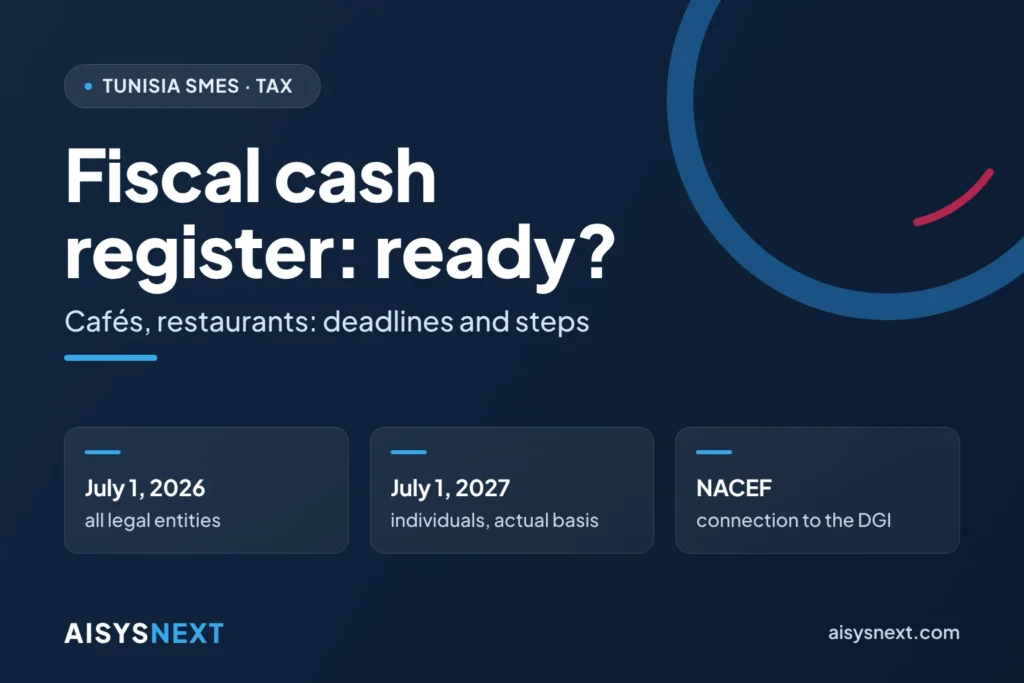
Short answer: A fiscal cash register is mandatory for all companies that sell food or drinks for on-site consumption: since November 1, 2025 for the first phase, and since July 1, 2026 for the other legal entities. Individuals follow on July 1, 2027, then July 1, 2028. You get equipped through a supplier on the list published on jibaya.tn, which connects your register to the NACEF system.
You run a fast-food restaurant set up as an SARL (limited liability company). The register works, the receipts print, and you thought the obligation only targeted tourist restaurants. Since July 1, 2026, it targets you too. On April 8, 2026, the DGI (tax administration) was already calling to order the first-phase establishments that had not joined the system.
Key points
- Legal texts: 2016 Finance Law (principle), Government Decree No. 2019-1126 of November 26, 2019 (procedures), order of October 14, 2025 (scope and timeline).
- November 1, 2025: companies operating restaurants classified as tourist restaurants, tea rooms, and 2nd- and 3rd-category cafés.
- July 1, 2026: all other legal entities in on-site consumption.
- July 1, 2027, then July 1, 2028: individuals, in two stages.
- Equipment: a supplier on the list published on jibaya.tn supplies or upgrades the register, then connects it to NACEF remotely.
- Penalties: the press cites Article 94 of the CDPF; we found no text specific to the lack of a register.
Who must install a fiscal cash register, and since when?
The order of the Minister of Finance of October 14, 2025 (JORT (Official Gazette) No. 125) covers any business that sells, as its main or secondary activity, prepared or ready-to-eat food or drinks and offers an on-site consumption area. It phases in the obligation over four stages.
| Phase | Date | Who gets equipped |
|---|---|---|
| 1 | November 1, 2025 | Legal entities operating restaurants classified as tourist restaurants, tea rooms, and 2nd- and 3rd-category cafés |
| 2 | July 1, 2026 | All other legal entities: fast-food outlets, ice cream parlors, sandwich shops run as companies, etc. |
| 3 | July 1, 2027 | Individuals under the actual-basis regime who must file monthly tax returns |
| 4 | July 1, 2028 | All other individuals running an on-site consumption business |
Three criteria therefore set your date: your legal form, the type of establishment for a company and, for an individual, your tax regime. The word “secondary” matters: an ancillary sale of food or drinks is enough, as long as you offer an on-site consumption area.
The principle dates back to the 2016 Finance Law. Our sources place it in Article 59 ter of the Personal Income Tax and Corporate Tax Code, but one cites Article 59 bis and another Article 48 of the 2016 Finance Law. Have the reference checked before you quote it in a letter.
What is an approved register, and what does it send to the DGI?
An approved register automatically sends each sale to a central DGI platform: the national NACEF system, whose practical procedures are set by Decree No. 2019-1126.
- It transmits the date, the time, the amount, the type of transaction and the operator’s identification.
- It produces a daily closing report.
- It prevents any change to or deletion of a recorded sale.
The supplier holds the approval, not you. Cash register software publishers and suppliers register on homologation.nacef.tn, download the technical and functional specifications and the procedures manual, pass integration tests with the central system, then file their accreditation application before they start selling.
The list of approved suppliers appears on jibaya.tn; our sources do not give their number. Do not confuse a cash register with management software: for an ERP, no approval exists; for a restaurant register, insist that the supplier appears on the list.
What penalties apply if you are not equipped?
The press cites imprisonment from sixteen days to three years and a fine of 1,000 to 50,000 TND, based on Article 94 of the Code of Tax Rights and Procedures (CDPF). It draws this reading from tax advisor Mohamed Salah Ayari.
Caveat: Article 94 targets failure to invoice. We found no text that sets a penalty specific to failing to install a register. Treat these amounts as a risk reported by the press, and ask your advisor for the exact applicable legal basis.
On the ground, on April 8, 2026, the DGI called to order the phase 1 establishments missing from NACEF. On April 15, experts noted a five-month delay. Our sources contain no official connection statistics.
Which mistakes delay compliance?
The first mistake is to assume you fall outside the scope.
- “This only targets tourist restaurants.” Since July 1, 2026, all legal entities in on-site consumption fall within the scope.
- “My coffee corner is only a secondary activity.” The order covers the main activity and the secondary activity alike.
- Buying a register from outside the list. The procedure goes through a supplier on the jibaya.tn list, which handles the connection to the central system.
- Trusting the word “approved” in a brochure. Look for the supplier’s name on the list itself.
- Waiting until the day before the deadline. For phase 3, less than nine months remain as of October 9, 2026.
- Keeping old cash register habits. The fiscal register prevents you from correcting or erasing a sale: train the team before go-live.
How to get equipped: the step-by-step process
You contact a supplier on the list, it upgrades your register or supplies a compliant one, then it connects the register to the central system. The DGI press release of April 8, 2026 specifies that the procedure takes place entirely remotely.
- Find your place in the timeline. Company or individual? Actual-basis regime with monthly returns or not? Have your chartered accountant confirm your phase.
- Open the list of approved suppliers on jibaya.tn.
- Contact several suppliers on the list. Ask in writing whether they upgrade your current register or replace it. Our sources give no prices: compare the quotes.
- Let the supplier connect the establishment to NACEF and keep a written record of the operation.
- Train your team: identification of each operator, daily closing, no after-the-fact corrections.
- Reconcile every day the closing report, the cash receipts and your accounts. A tool that unifies sales, accounting and inventory avoids re-entering data.
If in doubt, the DGI gives two contacts in its April 8, 2026 press release: the Remote Tax Information Center at 81 100 400 and its approval unit at 71 780 347.
How AISYSNEXT supports you
Your fiscal cash register comes from a supplier on the list published on jibaya.tn. AISYSNEXT works on everything around it: your organization and your management, alongside your chartered accountant.
- We audit your cash collection, purchasing and inventory processes, and we work with you to frame the questions to ask cash register suppliers.
- We configure AROVA ERP for your purchasing, inventory, accounting and human resources.
- We study with you how to connect your management system to your fiscal cash register data, and we develop it on quote.
- We train your teams and provide support from Tunis.
Describe your establishment to us in a free quote request, or contact our team.
Frequently asked questions
My café is a sole proprietorship: by what date must I get equipped?
July 1, 2027 if you fall under the actual-basis regime and file monthly tax returns. July 1, 2028 in all other cases. Have your chartered accountant confirm your regime.
Can I keep my current register?
Perhaps. According to the DGI press release of April 8, 2026, the supplier upgrades the existing register or supplies a compliant one. A supplier on the list will tell you whether your equipment can be upgraded.
How much does a fiscal cash register cost?
Our sources publish no prices, whether for the hardware, the upgrade or the connection. Ask several suppliers on the list for a written quote and compare the total cost.
Is a pastry shop with a few tables affected?
Yes, if it sells prepared or ready-to-eat food or drinks and offers an on-site consumption area, even as a secondary activity. Its date then depends on its legal form, its type of establishment and its tax regime.
Sources
- JIBAYA portal — notice to cash register software publishers and suppliers
- Business News — DGI press release of April 8, 2026
- Business News — what changes on July 1, 2026
- La Presse — order of October 14, 2025
- Kapitalis — timeline of the four phases
- Managers — legal basis and how NACEF works
- Business News — penalties cited, April 15, 2026
- Webdo — five months behind schedule, April 15, 2026
Article up to date as of October 9, 2026. It provides information and does not replace the advice of your chartered accountant or legal counsel.