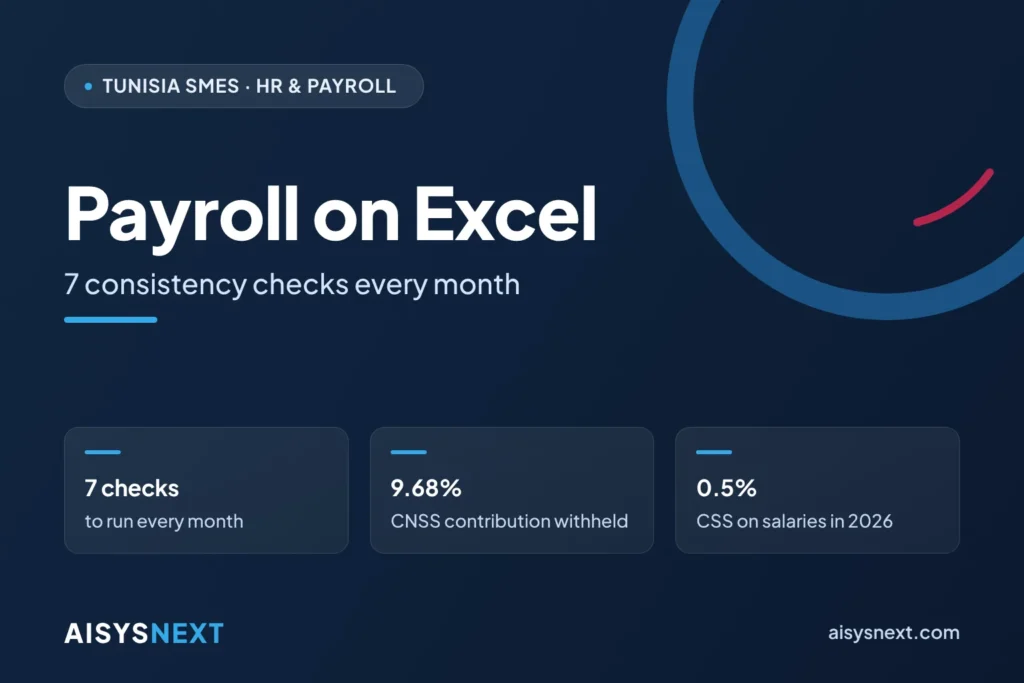
Short answer: As long as your payroll runs on Excel, seven monthly checks keep it consistent with the CNSS (National Social Security Fund) and with your taxes: parameters, headcount, CNSS contribution base, taxable base, declared withholdings, TFP and FOPROLOS, and certificates on TEJ (the online tax data exchange platform). A Tunisian SME needs payroll software or a management tool when these checks no longer close before the deadlines, or when you enter the same salary in three places.
The payslip comes out of one Excel workbook. The monthly tax return comes from another tab, the quarterly CNSS salary declaration from a third file, and someone enters the withholding certificates on TEJ. The gap shows up the day an auditor lays these documents side by side.
Key points
- Rates to check: CNSS contribution withheld at 9.68% (9.18% in older files) and social solidarity contribution (CSS) at 0.5% on salaries paid from January 1 to December 31, 2026.
- Personal income tax (IRPP): an eight-bracket scale, from 0% to 40%, in force since January 1, 2025 (Law No. 2024-48, Article 36).
- Vocational training tax (TFP) and FOPROLOS (housing fund contribution): 2% of gross payroll (1% for manufacturing industries) and 1%, benefits in kind included.
- Monthly tax return: the 15th for individuals, the 20th for legal entities that file and pay online, the 28th for other legal entities.
- Withholding certificates: issued on TEJ no later than the end of the month following payment (order of May 10, 2024, Article 8); the inclusion of salaries in TEJ as of January 1, 2026 remains to be confirmed.
Why don’t payroll, CNSS and tax figures match?
The returns come from separate data entries, on different schedules, and each one handles benefits in kind, bonuses and back pay in its own way. Yet the monthly tax return, the certificates on TEJ, the quarterly CNSS salary declaration and the annual employer return (due no later than April 30 of the following year) all draw on the same payslips.
2026 adds a further difficulty: the decrees of April 30, 2026 on salary increases apply from January 1, 2026, which means four months of payroll to recalculate for each employee.
What are the seven consistency checks to run each month?
The first four check the payroll itself; the next three check that the tax returns carry it over correctly.
| Check | You compare | Typical gap | Fix |
|---|---|---|---|
| 1. Parameters | The rates in the workbook and those for the year: CNSS at 9.68%, CSS at 0.5%, eight-bracket IRPP scale | Contribution still at 9.18%, CSS at 1%, old scale | Dated parameter table, kept separate from the calculations, reviewed in December and after each decree |
| 2. Headcount | The people paid and the employee records | Forgotten fixed-term or seasonal worker, missing CNSS registration number or national ID card (CIN) number | Mandatory fields in the employee record, declaration on hiring |
| 3. CNSS base | The month’s gross pay and the cumulative amount for the quarterly declaration | Benefit in kind, bonus or back pay present on one side only | Gap explained in the same month; the three months make up the declared base |
| 4. Taxable base | Gross pay subject to contributions and taxable gross pay | Pay item classified on the wrong side, professional expenses above the cap | Closed list of the pay items that separate the two bases |
| 5. Withholdings | The IRPP and CSS on the payslips and the amount declared in the month | Bonus or back pay paid outside the cycle, payslip corrected after filing | Payroll locked before the return, corrections tracked |
| 6. TFP and FOPROLOS | The declared base and total gross pay, benefits in kind included | Benefit in kind missing from the base, wrong TFP rate | Base taken from check 3 |
| 7. TEJ certificates | The withholdings made the previous month and the certificates issued | Certificate never issued, issued on paper or late | Monthly issuance, by manual entry or by XML file |
How do you read a gap, and what do you risk if it remains?
You put a figure on a gap, explain it by a rule, then correct it, as in these four cases.
- The outdated rate. Example: for a gross salary of 1,500 TND, a contribution withheld at 9.18% instead of 9.68% gives 137.7 TND instead of 145.2 TND, a gap of 7.5 TND. With 20 employees at this level, the gap reaches 150 TND per month and 450 TND per quarter.
- The legitimate gap between the two bases. Since the 2026 Finance Law (Article 22), home-to-work transportation that the employer provides to blue-collar workers falls outside the IRPP base but remains subject to social contributions. The deduction for professional expenses (10% of income after mandatory contributions) is capped at 2,000 TND per year.
- The forgotten benefit in kind. Example: 2,000 TND missing from the base means 40 TND of TFP at the 2% rate and 20 TND of FOPROLOS left undeclared.
- The missing withholding. Failing to withhold the CSS exposes the employer to a fine equal to the amount not withheld, doubled for a repeat offense within two years.
On TEJ, once the deadline has passed, issuing a certificate requires prior written authorization from the tax audit office and does not cancel the penalty (order of May 10, 2024, Articles 10 and 11). Two points remain to be confirmed with your chartered accountant: the fine of 30% of the withholding (minimum 50 TND) for a certificate issued outside the platform, which the press reports but whose legal article we have not reviewed; and the inclusion of salaries in the scope of TEJ as of January 1, 2026, which we read in a summary of the order.
On the CNSS side, a late declaration costs a penalty of 1% per month. We do not put a figure here on the tax late-payment penalties for withholdings, as we have no verified up-to-date text. See our articles on calculating net salary in 2026 and on tax and CNSS late-payment penalties.
When does payroll software or a management tool become necessary?
A tool becomes necessary when the seven checks no longer fit into the calendar, not at a specific headcount. Four signals point to it:
- you enter the same salary three times, for payroll, the CNSS and taxes;
- retroactive back pay forces you to recalculate several months by hand, as in 2026;
- a platform rejects your files because a specification or an XSD schema has changed (the DGI, Tunisia’s tax administration, updated the TEJ schema in September 2026);
- gaps appear after filing, never before.
A management tool then provides a single source of payroll data, recalculation by period with a separate back-pay payslip, and reconciliation reports before filing. See our guide to moving from Excel to an ERP.
According to the Miqyes barometer (CONECT and UNDP, 502 SMEs with 6 to 199 employees), 21.3% of SMEs use an ERP: 15.1% among those with 6-9 employees, 37.9% among those with 50-200. The report also shows 33.3% on a chart, so treat these figures as an order of magnitude. We found no public statistics on the share of SMEs that run their payroll on Excel.
To watch: without a new provision in the 2027 Finance Law, the CSS returns to 1% on January 1, 2027. As of October 9, 2026, we know of no payroll measure in the draft law.
How AISYSNEXT supports you
AISYSNEXT works alongside your chartered accountant to make the data that feeds your payroll and returns reliable.
- We audit your payroll process: who enters what, and where the gaps arise.
- We configure AROVA ERP to bring personnel files, leave, attendance and payroll items together in a single database, along with accounting.
- We review with you the reconciliation reports and exports your returns require, and we develop them on a quote basis.
- We migrate your Excel data, train your teams and provide support from Tunis, in French, Arabic or English.
Frequently asked questions
Can you keep running payroll on Excel in Tunisia?
Yes, as long as you carry out the seven checks every month. The texts cited here set rates, deadlines and filing formats, not the calculation tool.
What should you do if payroll and the CNSS declaration give different totals?
Isolate the pay item that explains the gap: benefit in kind, bonus, back pay or a forgotten employee. Then regularize it with your chartered accountant before the next filing.
When should you issue a withholding certificate on TEJ?
No later than the end of the month following the month of payment, under Article 8 of the order of May 10, 2024. Check it at the end of each month: payments of the previous month = certificates issued.
Sources
- DGI — common note (note commune) No. 3/2025, IRPP scale
- Order of May 10, 2024 — withholding certificates on TEJ
- Ministry of Finance — TFP and FOPROLOS
- PwC — other taxes in Tunisia
- Deloitte Société d’Avocats — 2026 Finance Law
- La Presse — CSS, 2026 terms
- CONECT and UNDP — Miqyes report 2024
Article up to date as of October 9, 2026. It provides information and does not replace the advice of your chartered accountant or legal counsel.