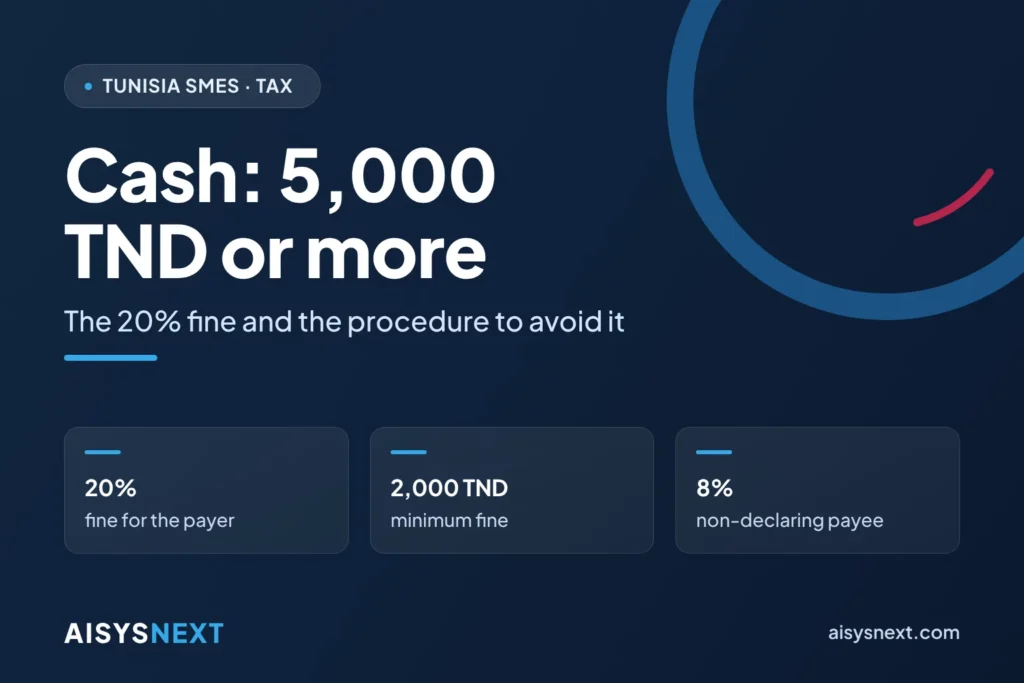
Short answer: Since January 1, 2023, a business that pays in cash for a purchase of 5,000 TND or more including VAT faces a 20% fine, with a minimum of 2,000 TND. A supplier that collects 5,000 TND or more excluding VAT in cash risks 8% if it does not declare the customer’s full identity and the amounts. The expense and the VAT remain deductible: the fine replaced the former exclusion.
Your buyer pays 7,000 TND in cash at a supplier’s counter, the invoice arrives, and the accountant records it. Nobody committed fraud, and yet this payment exposes your company to a 2,000 TND fine. Cash use is growing: according to the World Bank, cited by Managers, cash accounted for 18.8% of the M3 money supply in May 2026, compared with 16.6% in January 2025.
Key points
- Threshold: 5,000 TND or more including VAT paid in cash for a purchase of goods, services or fixed assets, since January 1, 2023.
- Payer side: 20% fine, minimum 2,000 TND (Article 60 of Decree-Law No. 2022-79, common note (note commune) No. 10/2023).
- Payee side: 8% fine on amounts of 5,000 TND or more excluding VAT collected in cash and not declared (CDPF, the Code of Tax Rights and Procedures; common note No. 10/2023).
- Deduction: since 2023, the expense, the depreciation and the VAT remain deductible despite the cash payment.
- Holding cash: since Decree-Law No. 2024-3 of October 14, 2024, the law no longer penalizes holding cash.
What is the rule for a cash payment of 5,000 TND or more?
The rule penalizes paying in cash, not holding cash. Article 60 of Decree-Law No. 2022-79 imposes a fine on the business customer that pays 5,000 TND or more including VAT in cash to buy goods, services or fixed assets. Common note No. 10/2023 explains how it applies to payments made since January 1, 2023.
The Code of Tax Rights and Procedures (CDPF) targets the supplier that collects 5,000 TND or more excluding VAT in cash without entering the customer’s full identity and the amounts in its annual employer return.
The two thresholds differ: the payer counts VAT included, the payee VAT excluded. An invoice below 5,000 TND excluding VAT that reaches this amount once VAT is added already exposes the customer.
How much is the fine, for the payer and for the payee?
The payer risks 20% of the amount paid in cash, with a floor of 2,000 TND; the payee risks 8% of the amounts collected in cash and not declared.
| Item | Payer (business customer) | Payee (supplier) |
|---|---|---|
| Threshold | 5,000 TND or more including VAT | 5,000 TND or more excluding VAT |
| Fine | 20%, minimum 2,000 TND | 8% |
| Legal basis | Article 60 of Decree-Law No. 2022-79 | CDPF (common note No. 10/2023) |
- Example 1: you pay 6,000 TND including VAT in cash. The calculation gives 6,000 × 20% = 1,200 TND, less than the floor: the fine comes to 2,000 TND, one third of the purchase.
- Example 2: you pay 25,000 TND including VAT in cash. Fine: 25,000 × 20% = 5,000 TND.
- Example 3: you collect 12,000 TND excluding VAT in cash without declaring the customer. Fine: 12,000 × 8% = 960 TND.
The floor applies up to 10,000 TND, since 10,000 × 20% = 2,000 TND. For a payment of 5,000 TND, the fine represents 40% of the purchase.
Do the expense and the VAT remain deductible after a cash payment?
Yes. Since 2023, the law no longer excludes from deduction the expenses, depreciation and VAT linked to cash payments: the 20% fine replaces that exclusion. Common note No. 10/2023 relies on Articles 14 and 15 of the Personal Income Tax and Corporate Tax Code, on Article 10 of the VAT Code and on Article 60 of Decree-Law No. 2022-79.
Many online guides still claim that VAT paid in cash above 5,000 TND, or even above 1,000 TND, is not deductible. The Ministry of Finance’s own tax overview page itself mentions this exclusion: on this point, the page is no longer up to date.
That does not make cash neutral again: the invoice remains deductible, but paying it in cash costs you a separate fine.
Split payments, deposits, advances: which situations expose you?
The risk arises wherever cash changes hands with no check on the total committed with a single supplier:
- a cash deposit when ordering, then a cash balance on delivery;
- an order split into several invoices or several installments;
- a cash advance handed to a site foreman, who then pays a supplier that demands cash;
- a customer who pays you in cash without you recording their full identity.
Point to confirm: our sources do not specify how the tax administration assesses a purchase of 5,000 TND or more paid in several installments, or a deposit followed by a balance. We therefore claim neither that splitting a payment escapes the fine, nor the opposite. Until you have your chartered accountant’s opinion, with common note No. 10/2023 in hand, apply the threshold to the total of the order.
Which internal procedure should you set up starting Monday?
A written rule and a check before every disbursement remove most of the risk.
- Write the rule down. No cash payment of 5,000 TND or more including VAT: bank transfer or bill of exchange. Circulate it to buyers and cashiers.
- Set up an approval workflow. Every supplier payment goes through an approval step that blocks cash from the threshold upward. While you are at it, check the supplier’s withholding tax rate.
- Track the running total. Add up cash payments per supplier and per order, not just per cash disbursement.
- Trace your cash receipts. For any cash receipt of 5,000 TND or more excluding VAT, record the customer’s full identity and the amount on the spot, for the annual employer return.
- Reconcile every month. Compare the cash journal, the invoices and the bank statements, and submit any discrepancies to your chartered accountant.
What should replace cash: bank transfer, check or bill of exchange?
Replace cash with a bank payment method, preferably a bank transfer or a bill of exchange.
- The bank transfer leaves a dated bank record that you can reconcile with the invoice.
- The check is governed by Law No. 2024-41, in force since February 2, 2025: each check is capped at 30,000 TND, and the beneficiary verifies the funds and then reserves the amount on the TuniChèque platform.
- The bill of exchange spreads the payment, but watch the due date: the BCT (Central Bank of Tunisia) reports a 9.5% rejection rate for bills of exchange in the first half of 2026.
How AISYSNEXT supports you
AISYSNEXT starts from your actual cash flows, not from a piece of software. Our team works alongside your chartered accountant, without replacing them.
- We audit your collection and disbursement circuits: cash desks, advances, over-the-counter purchases, job sites.
- We configure AROVA ERP (purchasing and suppliers, invoicing and accounting) and develop the controls you need on a quote basis, for example a block on cash payments from the threshold upward.
- We migrate your customer and supplier records as part of an ERP and CRM integration project.
- We train your buyers, cashiers and accountants, then provide support from Tunis.
Describe your organization to us in a free quote request or contact our team.
Frequently asked questions
Can a business keep more than 5,000 TND in cash on its premises?
Yes, according to Business News and Managers: Decree-Law No. 2024-3 of October 14, 2024 repealed Article 16 of the 2014 Supplementary Finance Law. The law no longer penalizes simply holding cash, whatever the amount.
Who pays the fine: the customer or the supplier?
Each is liable for its own. The business customer bears the 20% because it paid in cash. The supplier bears the 8% if it did not declare the customer’s full identity and the amounts.
Is paying in several installments enough to avoid the fine?
We cannot say that it is: our sources settle neither split payments nor deposits. To be safe, base your reasoning on the total of the transaction and ask your chartered accountant.
Sources
- Note commune No. 10/2023 (jibaya.tn) — fines on cash payments, deduction
- Ministry of Finance — general overview of taxation
- Business News — cash transactions, February 4, 2026
- Managers — holding cash, December 26, 2025
- Managers — share of cash in the money supply, September 23, 2026
- Kapitalis — check law and TuniChèque, February 3, 2025
- Business News — payments in the first half of 2026, August 15, 2026
Article up to date as of October 9, 2026. It provides information and does not replace the advice of your chartered accountant or legal counsel.