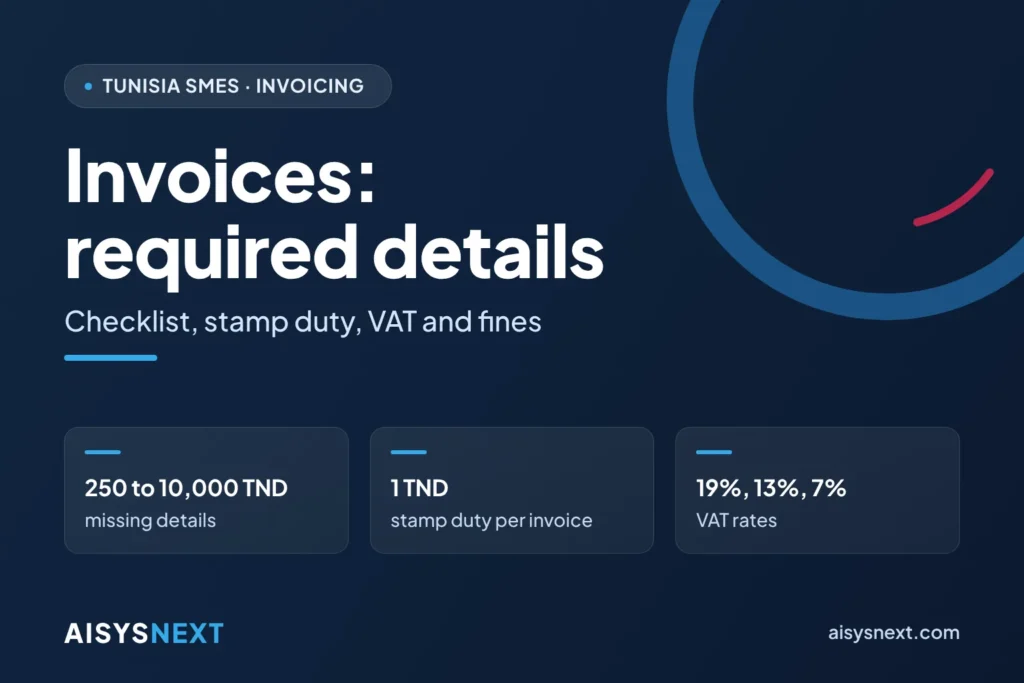
Short answer: Article 18 of the VAT Code requires every invoice to show the transaction date, the customer’s identity, address and tax ID (matricule fiscal), the supplier’s tax ID, the description, the price excluding VAT, and the VAT rates and amounts, under a number taken from an unbroken series. An incomplete invoice exposes you to a fine of 250 to 10,000 TND (Article 95 of the CDPF, the Code of Tax Rights and Procedures). Add the 1 TND stamp duty per invoice.
A customer sends an invoice back to you: their tax ID is missing. The following month, your accountant finds two invoices with the same number, then a gap in the series. In front of a tax auditor, each omission becomes an offense, and your customer can reject the document.
Key points
- Legal basis: Article 18 § II of the VAT Code, one invoice for each transaction.
- VAT: standard rate of 19%, reduced rates of 13% and 7% (Article 7).
- Stamp duty: 1 TND per invoice since 2023.
- Missing details: fine of 250 to 10,000 TND (Article 95 of the CDPF).
- Irregular numbering: 50 to 1,000 TND per invoice (Article 96).
What details must an invoice show in Tunisia?
Article 18 § II of the VAT Code sets the list: every taxable person, except those under the flat-rate regime, issues an invoice for each transaction and includes the details below. Check your template against it.
| Required detail | What you check |
|---|---|
| Transaction date | Present on every invoice |
| Number | Unbroken series: no duplicates, no gaps (Article 18 § III) |
| Supplier’s tax ID | Yours, fixed in the template header |
| Customer’s identity and address | Taken from the customer record |
| Customer’s tax ID | Present for any customer required to file a declaration of existence |
| Description of the goods or service | On every line |
| Price excluding VAT | Shown line by line |
| VAT rates and amounts | The rate and the amount |
A note on the customer’s tax ID. The two versions of the text we consulted differ: the 9anoun.tn version requires this detail when the customer must file a declaration of existence; the Jurisite version presents it as deleted. We follow 9anoun, the more recent one. In practice, include the tax ID of every business customer: Tunisie TradeNet (TTN) checks the customer’s tax identifier in any case.
Which situations add obligations?
- Sales under VAT suspension: the invoice states the amount of suspended tax, and you file a quarterly list of these invoices with the tax administration.
- Electronic invoice: it carries the same details and adds the issuer’s electronic signature and a unique reference assigned by TTN (Government Decree No. 2016-1066 of August 15, 2016).
- Transport: an invoice, or a document that serves as one, accompanies the goods.
Which VAT rates and stamp duty go on the invoice?
Three VAT rates have applied since January 1, 2018: the standard rate of 19% and two reduced rates, 13% and 7% (Article 7 of the VAT Code). The stamp duty has been 1 TND per invoice since 2023 (Decree-Law No. 2022-79).
- Professional fees: lawyers, accountants, consultants and similar professions have invoiced at 19% since January 1, 2023, compared with 13% before (Article 44 of Decree-Law No. 2022-79).
- Flat-rate regime and self-employed (auto-entrepreneur) regime: these businesses do not charge VAT and do not recover it.
Example: you invoice 1,000 TND excluding tax at the 19% rate. The VAT comes to 1,000 × 19% = 190 TND. With the 1 TND stamp duty, the customer pays 1,000 + 190 + 1 = 1,191 TND.
Since January 1, 2026, large retailers with a sales area above 1,500 m² have applied their own scale: 1 TND below 50 TND, 1.500 TND from 50 to 100 TND, 2 TND above 100 TND (Article 20 of Law No. 2025-17, common note (note commune) No. 11/2026). Read 1.500 TND as one dinar and 500 millimes.
What fines apply to an incomplete or misnumbered invoice?
The Code of Tax Rights and Procedures (CDPF) sets a fine of 250 to 10,000 TND when an invoice, paper or electronic, lacks the details required by Article 18. The administration applies it per offense found, regardless of the number of invoices.
| Breach | Penalty | Basis |
|---|---|---|
| Missing required details | 250 to 10,000 TND; doubled for a repeat offense within two years | Article 95 of the CDPF |
| Invoices not numbered, or numbered irregularly or non-sequentially | 50 to 1,000 TND per invoice used; 1,000 to 50,000 TND for printing them; doubled for a repeat offense within two years | Article 96 of the CDPF |
| Paper invoice where the law requires an electronic invoice | 100 to 500 TND per invoice, up to a cap of 50,000 TND | Article 94 of the CDPF (Article 71 of Law No. 2024-48) |
| Failure to issue invoices, understated or fictitious invoices | Imprisonment from sixteen days to three years and a fine of 1,000 to 50,000 TND | Article 94 of the CDPF |
Example: an audit finds 40 invoices with non-sequential numbering. Article 96 counts per invoice: between 40 × 50 = 2,000 TND and 40 × 1,000 = 40,000 TND.
Two caveats. Our sources disagree on the period covered by the 50,000 TND cap: per audit or per fiscal year. As of October 9, 2026, for services, the administration has announced that it will not impose penalties until the platform is fully operational; no law provides a basis for this leniency. Read our status report on e-invoicing.
Which mistakes come up most often?
Three defects dominate: missing Article 18 details, non-sequential numbering and a missing customer tax ID.
- Several templates in circulation, each with its own omissions.
- A number entered by hand, a source of duplicates and gaps.
- A poorly maintained customer file: missing or wrong tax IDs, duplicate records.
- Inconsistent VAT rates from one invoice to the next.
- Goods transported without a paper copy of the electronic invoice or an equivalent document: a fine of 20% of their value, minimum 500 TND (Article 95 of the CDPF).
How do you lock down your invoice template in your management software?
Check the required details at data entry rather than at sending: the software rejects an incomplete invoice before it goes out.
- Enforce a single template, with your tax ID, the Article 18 details and a line for the stamp duty.
- Automate numbering: the software assigns the number and locks the series for each fiscal year.
- Make required fields blocking: no validation without a date, customer, tax ID, description, price excluding VAT and rate.
- Clean up the customer file: duplicates, addresses, tax IDs.
- Set the VAT rate in the item record, not at the time of sale.
- Check the series every month and submit any discrepancies to your chartered accountant.
- Prepare for the next step. A clean template simplifies your enrollment in El Fatoora, the TTN e-invoicing platform.
How AISYSNEXT supports you
AISYSNEXT starts from your actual invoices and works alongside your chartered accountant, without replacing them.
- We audit your invoicing process: template, numbering, customer file, delivery notes.
- We configure AROVA ERP (sales, invoicing and accounting) and develop, on quote, the controls specific to your business, for example fields that block validation.
- We migrate your customer and item records.
- We train your teams and provide support from Tunis.
Send us a sample invoice with your free quote request, or contact our team.
Frequently asked questions
Is the customer’s tax ID mandatory on the invoice?
Yes, according to the most recent version we consulted, when the customer must file a declaration of existence. Another version presents this detail as deleted: have your chartered accountant confirm it.
Does a fee note follow the same rules as an invoice?
Yes. Article 18 § II bis of the VAT Code subjects fee notes issued by non-commercial professions to the same details and the same penalties. The professional also shows their tax ID on all their documents.
Is a delivery note enough during transport?
Yes, if it shows the date, the names, the addresses, the type and the quantity. Door-to-door sales require an exit slip, and imports a customs document.
Sources
- ARP (Parliament) — report of February 10, 2026
- Jurisite Tunisie — VAT Code, Article 18
- 9anoun.tn — VAT Code, Article 18
- Jurisite Tunisie — CDPF, Articles 94 to 96
- Jurisite Tunisie — 2025 Finance Law, Article 71
- KPMG Tunisie — tax circular, February 2026
- PwC — VAT and stamp duty
- Managers — stamp duty for large retailers
Article up to date as of October 9, 2026. It provides information and does not replace the advice of your chartered accountant or legal counsel.