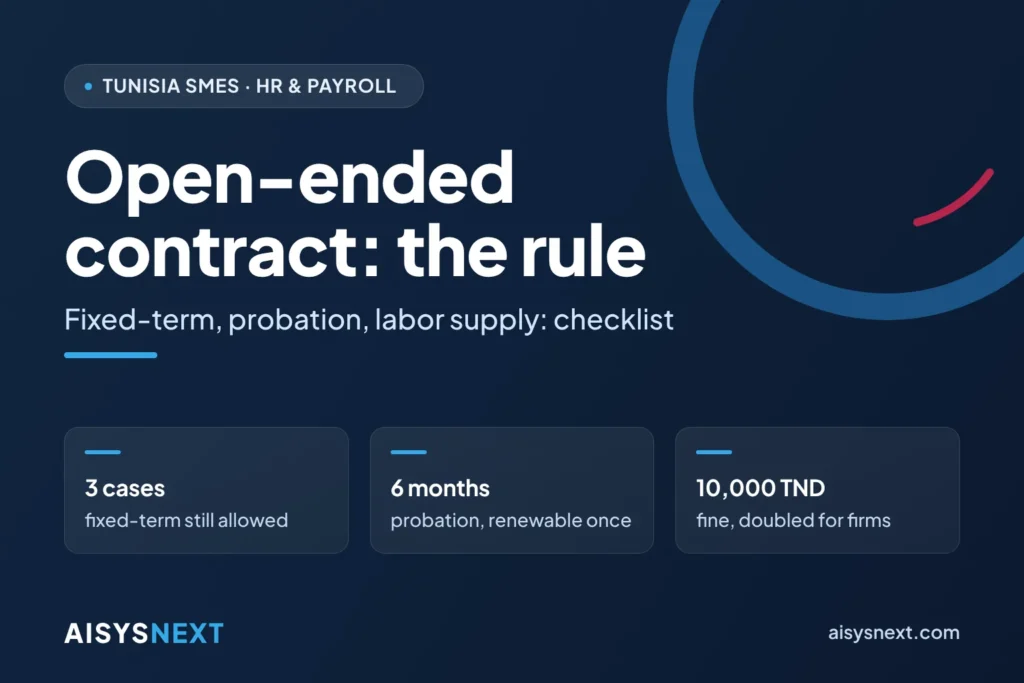
Short answer: Since Law No. 2025-9 of May 21, 2025, the open-ended contract (CDI) is the rule in Tunisia. You may sign a fixed-term contract (CDD) only in three specific cases, the probation period may not exceed 6 months, renewable only once, and the law prohibits labor subcontracting, with a fine of 10,000 TND, doubled for a company.
Your contract templates predate May 2025. You sign one fixed-term contract after another out of habit, a service provider places staff at your disposal, and no one tracks probation end dates. These practices expose the company: the deadline for bringing service contracts into compliance expired at the end of August 2025.
Key points
- Legal text: Law No. 2025-9 of May 21, 2025, published in JORT (Official Gazette) No. 61 of May 23, 2025.
- Contracts: open-ended contract by default, fixed-term contract limited to three cases (new Articles 6-2 and 6-4 of the Labor Code).
- Probation period: 6 months maximum, renewable only once (new Article 6-3).
- Labor subcontracting: prohibited; fine of 10,000 TND, doubled for a legal entity, and 3 to 6 months of imprisonment for a repeat offense (new Articles 28 and 29).
- Service and works contracts: permitted under three conditions (new Article 30).
- Fixed-term contracts outside the permitted cases: fine per employee, capped at 10,000 TND in total (Article 234 ter); the per-employee amount still needs to be verified.
Open-ended or fixed-term: what does Law No. 2025-9 provide?
The open-ended contract becomes the default contract: the law presumes that every employment contract is concluded for an indefinite term (new Article 6-2 of the Labor Code). A fixed-term contract remains possible in three specific cases (new Article 6-4):
- a temporary and exceptional increase in workload;
- the temporary replacement of a permanent employee who is absent or whose contract is suspended;
- seasonal work, or activities that by their nature or by custom do not allow the use of an open-ended contract.
If the employee keeps working after the end date of the fixed-term contract, the contract becomes open-ended and the employee keeps their seniority (new Article 17). Fixed-term contracts concluded outside the three cases have become open-ended contracts, whether they were in progress when the law took effect or terminated after March 14, 2025; seniority counts if no break exceeds one year (Article 6 of the law).
We use May 23, 2025, the date of publication in the JORT, as the effective date. One source cites May 21, 2025: have your legal counsel confirm the date in the event of a dispute.
What is the maximum length of the probation period?
The probation period lasts 6 months at most, and you may renew it only once, for the same length (new Article 6-3). Three rules govern it:
- Termination: either party ends the probation in writing, with 15 days’ notice before it ends.
- No second probation: after a termination during probation, any new contract between the same parties is an open-ended contract with no probation.
- Contracts that predate the law: their probation periods remain valid up to a limit of 6 months (Article 7 of the law).
Example: a 6-month probation renewed once ends no later than 12 months after it starts.
Labor subcontracting: what is prohibited, and what is still allowed?
The law prohibits a company from placing its employees at the disposal of a user company (new Article 28). Security guarding and cleaning are expressly named within the scope of the ban.
You can still purchase a service or works contract, under three conditions (new Article 30):
- the provider brings professional expertise or technical specialization;
- the service stays outside the main, permanent activity of your company;
- the provider’s employees do not work under your authority.
The law adds three safeguards: a financial guarantee from the provider for wages and contributions, a direct right of action for employees and social security funds against the client company, and joint and several liability of the parties (Articles 30 quater to 30 sexies).
Employees placed at a company’s disposal automatically obtained permanent status in the client company when the law took effect, with their seniority carried over (Article 8 of the law). Service contracts had 3 months to comply with Article 30: that deadline expired at the end of August 2025 (Article 10).
What penalties apply, and which mistakes lead to them?
The heaviest penalty targets labor subcontracting: a 10,000 TND fine for an individual, double that for a legal entity.
| Breach | Penalty | Legal basis |
|---|---|---|
| Labor subcontracting, individual | Fine of 10,000 TND | New Article 29 of the Labor Code |
| Labor subcontracting, legal entity | Fine doubled, i.e. 20,000 TND; 10,000 TND for the legal representative involved | New Article 29 |
| Repeat offense | Imprisonment of 3 to 6 months | New Article 29 |
| Fixed-term contract outside the permitted cases, or non-compliant service contract | Fine per employee concerned, capped at 10,000 TND in total | Article 234 ter |
Example: an SARL (limited liability company) that uses staff placed at its disposal by a third party faces a 20,000 TND fine; its manager, if involved, faces 10,000 TND.
One amount remains uncertain: the per-employee fine under Article 234 ter. Some of the sources consulted state 100 to 300 TND, others 100 to 1,000 TND; only the 10,000 TND cap is consistent across all of them. Have the text published in JORT No. 61 checked.
Four mistakes keep coming up in SMEs:
- reusing a contract template that predates May 2025;
- signing a fixed-term contract without linking it to one of the three permitted cases;
- setting a probation period that is too long, or a new probation after a terminated probation;
- directing a provider’s employees day to day, or assigning the provider a task that belongs to your main, permanent activity.
Checklist: how do you bring your SME into compliance?
Carry out these seven checks with your legal counsel and keep a dated record of the audit.
- List all contracts: open-ended, fixed-term and service contracts, with their start, end and probation dates.
- Justify each fixed-term contract: link it to one of the three cases in Article 6-4 and state the reason in the contract.
- Regularize: treat as open-ended contracts the fixed-term contracts with no valid reason and the employees who stayed on after the end date, seniority included.
- Update your templates: probation of 6 months at most, a single renewal, termination in writing.
- Track deadlines from signature: end of probation, 15-day notice, end date of each fixed-term contract.
- Screen your service contracts against the three conditions of Article 30, security guarding and cleaning first, and ask the provider to prove its financial guarantee. In the construction sector, check works subcontracting the same way.
- Measure the impact: each employee taken on permanently adds to your payroll; recalculate the full cost of an employee for the employer.
How AISYSNEXT supports you
AISYSNEXT does not replace your legal counsel: it organizes your HR data so that you can apply your counsel’s recommendations.
- We audit your HR processes: where the contracts are kept, who tracks deadlines, which providers are involved.
- We configure AROVA ERP to centralize personnel files, leave, attendance and payroll data.
- We develop useful customizations on a quote basis, such as reminders for probation end dates or fixed-term contract end dates. For construction, BTPconstruct ERP tracks subcontracting, labor and time clocking.
- We train your teams and provide support from Tunis, in French, Arabic or English.
Request a free quote to scope your project.
Frequently asked questions
My employee on a fixed-term contract keeps working after the end date: what happens?
The contract becomes an open-ended contract and the employee keeps their seniority (new Article 17). So track the end date of each fixed-term contract and make your decision before that date.
Can I still outsource security guarding or cleaning to an outside company?
New Article 28 expressly names security guarding and cleaning within the scope of the ban. The sources consulted do not specify how these activities fit with the services that Article 30 permits: have your legal counsel assess each contract.
Does the law apply to contracts signed before May 2025?
Yes. Fixed-term contracts concluded outside the three permitted cases have become open-ended contracts (Article 6 of the law), and earlier probation periods remain valid up to a limit of 6 months (Article 7).
Sources
- Jurisite Tunisie — Labor Code, end of the employment contract (Article 17)
- Webmanagercenter — publication of Law No. 2025-9 in the JORT
- Juridoc — analysis of Law No. 2025-9
- Paie Tunisie — new law on employment contracts
- Managers — presumed open-ended contract, subcontracting and penalties
- Cabinet Chaexpert — amendments to the Labor Code
- Le Temps News — enforcement of the law, September 2025
Article up to date as of October 9, 2026. It provides information and does not replace the advice of your chartered accountant or legal counsel.