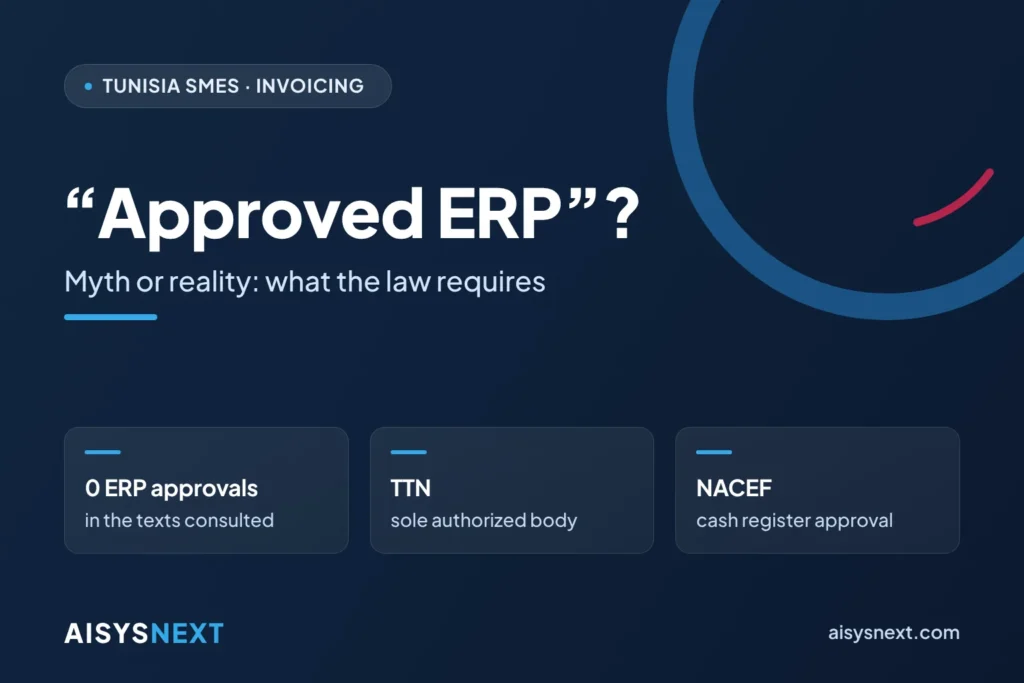
Short answer: No. None of the texts we consulted provides for the approval (homologation), certification or accreditation of an ERP or invoicing software by the Ministry of Finance or the DGI (tax administration). The law places obligations on your company: enroll with Tunisie TradeNet (TTN), produce the TEIF format, sign, archive and file the accounting program. Approval in the strict sense exists for fiscal cash registers.
You are comparing three software offers. Two display “approved ERP” (ERP homologué) or “accredited e-invoicing software”; the third says nothing about it and costs less. Before you pay for a label, check that it exists.
Key points
- No ERP approval in the texts consulted: Article 18 of the VAT Code, Decree No. 2016-1066, Article 71 of the 2025 Finance Law, Article 53 of the 2026 Finance Law, common note (note commune) No. 02/2026 (read in summary form).
- Only one “authorized body”: TTN, which manages the system (Decree No. 2016-1066, Article 2).
- The company enrolls, not the software: contract with TTN, enrollment certificate, declaration to the tax control office (Article 4 of the decree).
- Signature: certificate issued by ANCE (National Agency for Electronic Certification) under the TunTrust brand (Law No. 2000-83).
- Computerized accounting: filing of a copy of the program with the tax control office; retention of documents for at least ten years.
- Genuine approval: cash registers for on-site consumption, mandatory for all legal entities in the sector since July 1, 2026.
Is there an ERP approved by the Ministry of Finance?
No, none of the texts consulted sets up such a procedure. Government Decree No. 2016-1066 of August 15, 2016 recognizes only one “authorized body,” TTN, and provides for no accreditation of the software that connects to it.
Several vendors write “approved software,” “El Fatoora compatible” or “TEIF compliant” without citing the act or the authority. When the name of an authority does appear, the approval covers the electronic signature component and comes from ANCE/TunTrust; it does not cover the ERP.
Two nuances. In EDI mode, the company or its integrator goes through a TTN test account before going live: these tests validate a connection, not a piece of software. In addition, an integrator’s blog claims that TTN keeps an official list of approved solutions, with no link or reference. We were unable to consult the TTN website: this point remains unconfirmed.
What does the law actually require of your company?
The law asks five things of you, and all of them fall on the company, not on the software vendor.
| Obligation | What it involves | Basis |
|---|---|---|
| Enroll with TTN | Contract with TTN, enrollment certificate, declaration filed with the tax control office | Decree No. 2016-1066, Article 4 |
| Comply with the format | Invoice in TEIF format (Tunisian Electronic Invoice Format, an XML format), with the particulars required by Article 18 § II of the VAT Code | Decree, Articles 1 and 5 |
| Sign | Electronic signature of the issuer, then signature of TTN, unique reference and visible stamp (QR code) | Decree, Articles 3, 10 and 11 |
| Archive | TTN records and archives the invoices; you give a paper copy to the customer who asks for one; you keep your documents for ten years | Decree, Articles 6, 8, 9 and 12; Law No. 96-112 |
| File the accounting program | Copy of the program, initial or modified, handed over against an acknowledgment of receipt at the tax control office | Article 62 of the Personal Income Tax and Corporate Tax Code |
The decree sets no archiving period of its own: the ten years come from the general accounting rule. Filing the program is a declaratory formality: the administration issues in return neither an accreditation nor a certificate of compliance for the software. The ministry’s official page confirms this obligation without citing the article number; have your chartered accountant validate it.
In the event of a tax audit, Article 9 of the Code of Tax Rights and Procedures (CDPF) requires you to disclose to the officers the programs and software used to close your accounts, and to give them access to your purchasing, sales, invoicing and inventory management systems. The timetable for application to services remains under discussion: read our status report on e-invoicing in October 2026.
Where does genuine approval exist? Cash registers
Approval in the strict sense exists for the fiscal cash registers of cafés, restaurants and other on-site consumption businesses. Government Decree No. 2019-1126 of November 26, 2019 sets its procedures; the order of October 14, 2025 sets its timetable.
- Cash register software vendors and suppliers register on homologation.nacef.tn, download the specifications, run integration tests with the NACEF central system and file an accreditation application before going to market.
- The ministry publishes the list of approved suppliers on jibaya.tn.
- The obligation has covered all legal entities in the sector since July 1, 2026. It extends to individuals in two stages, on July 1, 2027 and then on July 1, 2028.
Specifications, tests, accreditation, public list: none of the texts consulted provides for any of these for an ERP. For a restaurant cash register, on the other hand, insist that the supplier appear on the list.
Which mistakes should you avoid when faced with an “approved ERP”?
The main mistake is to buy a word instead of proof.
- Paying for a label. The term is reassuring but corresponds to no act.
- Believing that the software bears the responsibility. Your company enrolls, signs and answers to the tax auditor.
- Thinking that an ERP is indispensable. Since September 15, 2026, the El Fatoora e-invoicing portal has made it possible to enter, sign and transmit invoices at low volume; according to the Ministry of Communication Technologies, it requires no specific integration solution.
- Forgetting to file the accounting program when you change software.
- Relying on technical data sheets. The details published by vendors contradict one another on the TEIF version, the signature format and the exchange protocol; only TTN’s documentation is authoritative.
Which questions should you ask a vendor before signing?
Ask for verifiable proof: put these seven questions in writing and attach the answers to the contract.
- Which authority issued the approval being advertised, through which act, on what date, and what does it cover: the signature, the cash register or the ERP?
- Can you show a TEIF file that TTN has accepted in production?
- Can you show a real invoice bearing the TTN reference and the QR code?
- Which customer that is already connected agrees to give a testimonial?
- Which TunTrust certificate does the solution use: DigiGo, ID-Trust key or legal entity seal?
- On what date, set in writing, will the TEIF format be available, and through which connection mode: Web or EDI?
- How does the solution handle the responses from TTN, acceptance or rejection?
How AISYSNEXT supports you
AISYSNEXT applies this rule to itself. We do not present ourselves as “approved,” and our ERPs carry no label of this kind, since none exists. We commit to verifiable work.
- We audit your invoicing workflow and define the need with your chartered accountant.
- We configure AROVA ERP for your sales, your invoicing and your accounting.
- We study with you how to connect your management system to El Fatoora and we develop that connection based on a quote, as custom development.
- We migrate your data and train your teams, with support from Tunis.
Put these seven questions to us: request a quote or first read how much an ERP project really costs.
Frequently asked questions
Is “TEIF compliant” software approved?
No. TEIF refers to the format that TTN imposes on electronic invoices. Producing a file that TTN accepts is a technical capability, not an accreditation.
Does TTN publish a list of approved software?
This point remains unconfirmed. An integrator’s blog claims so without a reference, and we were unable to consult the TTN website. Ask TTN directly; in any case, no text would give such a list the value of a regulatory approval.
Do I have to declare my accounting software to the tax administration?
Yes. If you keep your accounts on a computer, you file a copy of the program with the tax control office, against an acknowledgment of receipt. You also inform it of the nature of the equipment, its location and any change.
Can you issue electronic invoices without an ERP?
Yes, for a low volume. The El Fatoora portal, opened on September 15, 2026, lets you enter invoices, sign them and transmit them. EDI mode makes sense for high volumes.
Sources
- Ministry of Finance — accounting obligations under the actual-basis regime
- JIBAYA portal — notice to cash register software vendors
- JIBAYA portal — common note No. 02/2026
- ARP (Parliament) — hearing of February 10, 2026
- Droit-Afrique — Government Decree No. 2016-1066
- 9anoun.tn — CDPF, Article 9
- Business News — cash registers, reminder from the DGI
- L’Économiste Maghrébin — El Fatoora portal
Article up to date as of October 9, 2026. It provides information and does not replace the advice of your chartered accountant or legal counsel.