How much does an ERP cost for an SME? For a company with 1 to 100 employees, ERP Research puts the full project between $25,000 and $150,000 on the North American market, implementation included. The software is only part of that amount: integration generally costs one to three times the first-year license.
These benchmarks give an order of magnitude, not a quote. This article breaks down the six budget items, the hidden costs, and a method for building a realistic ERP budget.
ERP cost for SMEs: the key figures
| Benchmark | Value | Source |
|---|---|---|
| Full project, SME with 1 to 100 employees | $25,000 to $150,000 | ERP Research, 2026 |
| Full project, company with 100 to 500 employees | $150,000 to $750,000 | ERP Research, 2026 |
| Basic ERP for a small business, standard workflows | $25,000 to $100,000 | Innowise, 2026 |
| Cost per user over five years | About $7,200 | Software Path, 2025, cited by ERP Research |
| Implementation relative to the first-year license | 1 to 3 times | ERP Research, 2026 |
| Total five-year cost relative to the license | 3 to 5 times | ERP Research, 2026 |
| Duration of a deployment in an SME | 2 to 6 months | ERP Research, 2026 |
| Contingency margin to add to the budget | 10 to 20% | Innowise, 2026 |
Mind the context: these amounts rely on North American consultant rates, from $150 to $350 per hour according to ERP Research. A project run with a Tunisian vendor-integrator relies on different rates. Only a quote based on your actual scope gives you your amount.
Why a per-user price is not enough
Many companies compare ERPs on a monthly per-user rate or on a license price. This comparison hides the total cost of ownership, which you calculate over several years.
An ERP project adds up three families of costs:
- The entry cost: setup, configuration, and data migration.
- Recurring costs: subscriptions, hosting, support, and enhancements.
- The organizational cost: team time, training, and changing habits.
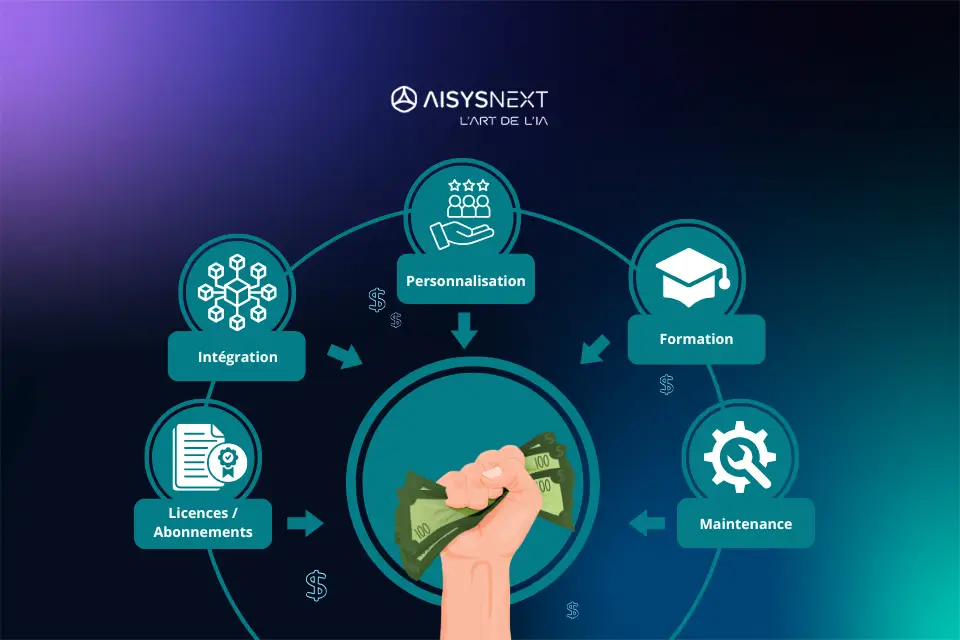
The six budget items of an ERP project
1. Software and licenses
An open source ERP does not charge a license fee, but it requires integration, hosting, and support. A SaaS or proprietary ERP charges a subscription per user or per module. The number of users and the modules you activate determine this item.
2. Hosting and infrastructure
You choose between managed cloud hosting and a dedicated server. Plan for the server subscription, backups, updates, and security.
3. Configuration and integration
This item is the heart of the project. It covers the analysis of your processes, module configuration, access rights, document templates, and connections with your other tools. ERP Research estimates that integration fees account for 40 to 60% of the implementation cost.
4. Data recovery and migration
You retrieve your files, clean them, then map them to the ERP fields before the import tests. ERP Research prices a simple migration from a single system at $10,000 to $25,000. The longer the history, the bigger this job gets.
5. Training and support
A poorly mastered ERP stays underused. This item includes training by profile, training materials, and support after go-live. Projects often devote 5 to 10% of the budget to it; ERP Research recommends 15 to 20% instead.
6. Support, maintenance, and enhancements
After go-live, you fund the help desk, fixes, updates, and small developments.
The hidden costs to anticipate
According to ERP Research, hidden costs add 15 to 30% to the real total. Innowise lists the most common ones:
- data cleansing before migration;
- the temporary drop in productivity at go-live;
- training for new hires after launch;
- late requests for reports and dashboards;
- integrations overlooked during scoping;
- the time your teams devote to the project.
How to build a realistic ERP budget in five steps
- Define a priority scope. Start with the critical processes: sales, invoicing, inventory.
- Move forward in phases. Launch the core business, then add the advanced modules.
- Separate entry costs from recurring costs. Distinguish installation from subscriptions, support, and hosting.
- Add a contingency margin. Set aside 10 to 20% for the needs that emerge during the project.
- Quantify the expected gains. Measure the time saved, the reliability of the data, and the visibility over the business.
To secure these steps, also read the key factors of a successful ERP implementation and the five indicators to track in your ERP.
The cost of doing nothing
Ask the opposite question too: how much does not having an ERP cost you today?
- Hours lost consolidating files.
- Errors that generate losses or tension.
- Sales opportunities that nobody handles.
- Decisions based on approximate figures.
A well-deployed ERP reduces these losses: it eliminates re-entry, makes invoicing reliable, and gives an up-to-date view of the business.
Open source, SaaS, or vendor-integrator: the effect on the budget
- General-purpose open source ERP: no license, but an integration and third-party module budget that depends on the integrator you choose.
- International proprietary ERP: a per-user subscription, options billed separately, and a network of resellers.
- Vendor-integrator: a single team develops the product, configures it, and provides support, which limits intermediaries.
To compare these models, see our AROVA ERP vs. Odoo page.
How AISYSNEXT keeps the cost of your ERP project under control
AISYSNEXT develops and deploys AROVA ERP, modular management software for all sectors, and BTPconstruct ERP for construction. Our approach acts on the items that weigh the most:
- Modules you activate as you need them: you start with the scope that serves your business.
- A phased deployment: we move forward module by module, including the migration of your data.
- A single team: the vendor, the integrator, and support work in Tunis, in French, English, or Arabic.
- A quote based on your actual scope: you know the entry cost and the recurring costs before you start.
Discover our ERP integration services in Tunisia, then request a quote for your ERP project or talk to an AISYSNEXT expert.
Frequently asked questions about ERP cost
What budget should an SME plan for an ERP?
ERP Research puts the full project between $25,000 and $150,000 for a company with 1 to 100 employees, based on North American rates. Your amount depends on the number of users, the modules, and the complexity of your processes.
How long does an ERP deployment take in an SME?
Allow 2 to 6 months for an SME, according to ERP Research. A phased deployment shortens the time to first results.
Is an open source ERP free?
No. The absence of a license fee does not remove integration, hosting, training, or support.
What contingency margin should you add to the budget?
Innowise recommends 10 to 20%: the low end of the range for a standard deployment, the high end for a complex migration or numerous integrations.
How can you reduce the cost of an ERP project?
Limit the initial scope, clean your data before migration, train your teams early, and choose a single point of contact for the software and the integration.
Sources
- ERP Research, ERP Implementation Cost Breakdown 2026, page revised September 21, 2026
- Innowise, ERP Implementation Cost, July 28, 2026
Article updated in October 2026. The amounts cited are market benchmarks in US dollars, not a price offer.