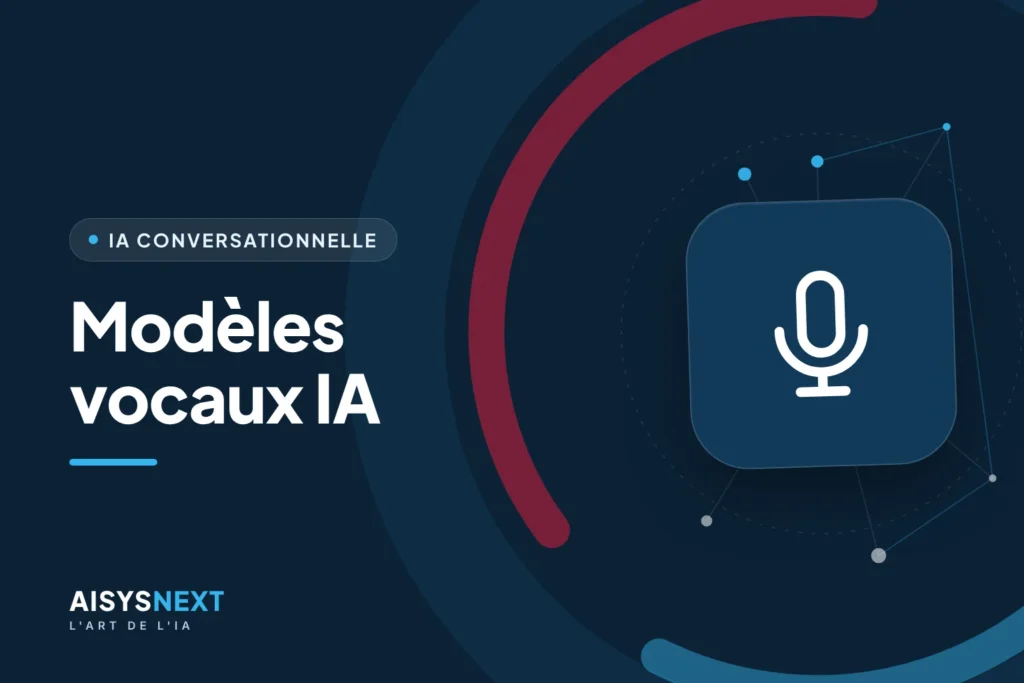
AI voice models are reaching a new milestone. OpenAI recently announced a new generation of voice models for its API that can reason, translate and transcribe speech more fluidly.
This advance marks an important step forward in the field of conversational artificial intelligence. It paves the way for voice experiences that are more natural, faster and smarter.
For businesses, this innovation can transform customer relationships, technical support, training, business applications and digital platforms.
What is an AI voice model?
An AI voice model is a technology that can understand, process and generate voice-based interactions.
Unlike traditional voice systems, these new models go beyond simple speech recognition. They can analyze context, understand a request, translate a conversation or produce a transcript in real time.
With this evolution, voice becomes a truly intelligent channel between the user and the digital system.
OpenAI strengthens the voice capabilities of its API
OpenAI has introduced new audio models for developers and businesses. The goal is to enable voice applications that perform better and feel more natural.
These models can be used in particular to:
- reason from a voice conversation;
- translate speech in real time;
- transcribe conversations automatically;
- improve intelligent voice assistants;
- connect voice to business tools.
This announcement confirms a strong trend: AI is becoming increasingly conversational.
Why AI voice models matter for businesses
AI voice models are more than a technical innovation. They can have a direct impact on productivity, customer experience and process automation.
For a company, voice can become a simple interface for interacting with a CRM, an ERP, a mobile app or an e-learning platform.
Instead of filling in a form by hand or searching for information in a spreadsheet, a user can simply talk to an intelligent assistant.
Smarter voice assistants
Traditional voice assistants often respond to a limited set of commands. With the new AI voice models, interactions become more natural.
An assistant can understand a complex request, ask follow-up questions, analyze the context and offer a relevant answer.
This can be very useful for:
- customer support;
- appointment scheduling;
- sales assistance;
- after-sales service;
- training platforms;
- business applications.
Real-time voice translation
Voice translation is one of the most promising uses of AI voice models.
It helps people who speak different languages communicate more easily. For businesses, it can improve exchanges with international customers, foreign partners or multicultural teams.
In training, this technology can also make content accessible to a wider audience.
Faster automatic transcription
AI voice models can also automatically transcribe conversations, meetings, calls or training sessions.
This feature saves time and helps organize information better. Companies can generate meeting minutes, archive exchanges or turn conversations into usable data.
AI transcription can be useful for:
- internal meetings;
- sales calls;
- training sessions;
- customer support;
- HR interviews;
- conferences and webinars.
Voice AI as a driver of digital transformation
Voice AI can become a real lever for digital transformation. It simplifies access to digital tools and makes applications more intuitive.
A company can integrate a voice assistant into its website, mobile app, CRM or ERP.
For example, a sales rep could dictate a report after a client meeting. The system could then automatically update the customer record, create a follow-up task and send a notification to the relevant team.
This kind of use reduces repetitive tasks and improves productivity.
Which sectors can benefit from AI voice models?
AI voice models can be used in many industries.
In customer service, they make it possible to build voice agents that answer frequent requests.
In training, they can support learners with interactive spoken explanations.
In healthcare, they can help transcribe conversations or structure information.
In retail, they can improve the shopping experience and customer assistance.
In industry, they can make business data easier to access in the field.
This technology can therefore adapt to many professional environments.
AISYSNEXT helps businesses integrate AI
At AISYSNEXT, we closely follow advances in artificial intelligence, intelligent solutions and digital transformation.
Our goal is to help businesses integrate AI in a way that is concrete, useful and suited to their real needs.
We support our clients in developing digital solutions and integrating CRM, ERP, web applications, mobile applications and intelligent AI-based tools.
AI voice models open up new possibilities for creating smoother experiences, automating processes and improving customer relationships.
Conclusion
The AI voice models announced by OpenAI represent a major advance for conversational artificial intelligence.
With voice, businesses can create experiences that are more natural, more accessible and more effective. Translation, transcription, customer assistance, interactive training and business automation become easier to integrate into digital tools.
The future of AI will not be text-only. It will also be voice-based, conversational and connected to the real needs of businesses.
Want to integrate artificial intelligence into your digital tools? AISYSNEXT helps you build intelligent, high-performing solutions tailored to your business.