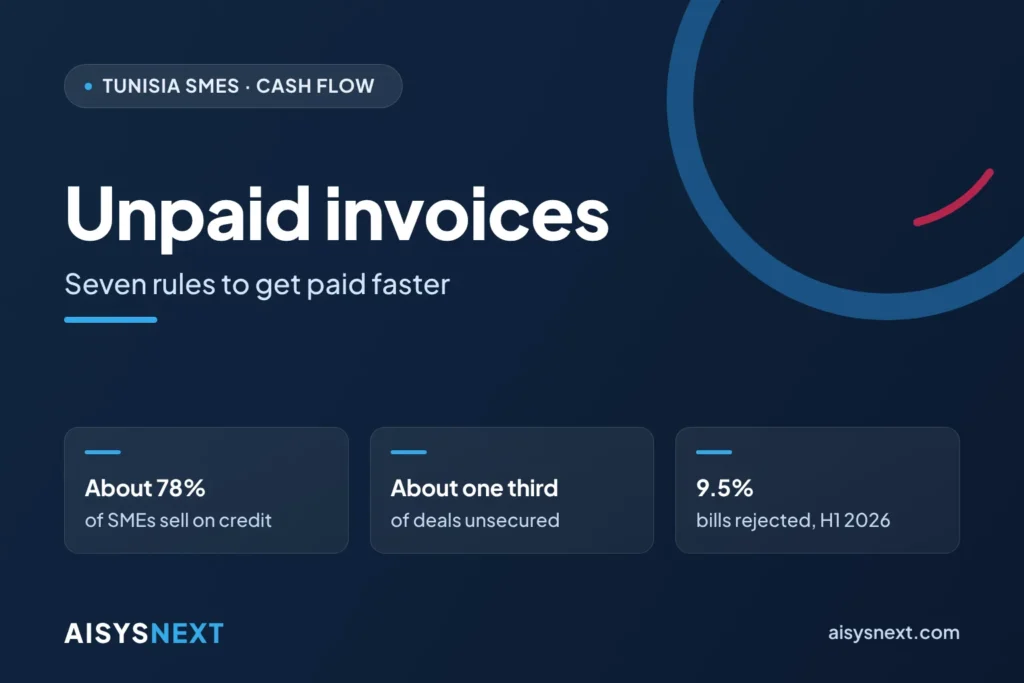
Short answer: To reduce unpaid customer invoices, write down your collection process from order to recovery: signed terms of sale, a down payment, an invoice issued on the day of delivery, scheduled reminders, weekly tracking of receivables, a payment method chosen according to its risk, and an escalation path decided in advance. According to the Miqyes barometer, about 78% of Tunisian SMEs sell on credit and about one third of transactions have no payment guarantee.
Your order book is full, but your bank account does not keep up. You deliver, you invoice at the end of the month, and you chase payment when the bank calls. In the meantime, you pay salaries, suppliers and taxes out of your own cash: you are financing your customers.
Key points
- Selling on credit: about 78% of SMEs sell on credit; about one third of transactions have no payment guarantee (Miqyes barometer).
- Financing: 28.6% of businesses cite access to finance as their main obstacle (World Bank).
- Bills of exchange: the BCT (Central Bank of Tunisia) reports that 9.5% of bills of exchange were rejected in the first half of 2026.
- Cash: a 20% fine (minimum 2,000 TND) applies to a business customer that pays 5,000 TND or more, including VAT, in cash.
- Statutory payment term between private companies: not confirmed as of October 9, 2026; set your payment terms in writing.
Why do unpaid invoices weigh so heavily on Tunisian SMEs?
Because selling on credit is the norm, and banks do not always make up for late collections.
According to the Miqyes barometer (CONECT/UNDP, April 2025, 502 SMEs), about 78% of SMEs sell on credit. Checks secure 53.4% of these sales, and about one third of transactions have no guarantee at all. Yet Law No. 2024-41 changed the rules on checks as of February 2, 2025, and bills of exchange show a 9.5% rejection rate in the first half of 2026, according to the BCT.
In the World Bank survey (645 companies, March 2024 to March 2025), 28.6% of businesses cite access to finance as their main obstacle. According to Miqyes, banks turned down 27.1% of SMEs’ short-term credit applications.
Example: your customer receivables reach 300,000 TND. If one third of that amount has no guarantee, 100,000 TND rest on nothing but your customers’ word. We found no Tunisian statistics on payment times between businesses: measure your own.
What are the seven rules for getting paid faster?
They follow the life of a sale, from the order to the unpaid invoice.
Rule 1: write down your terms of sale and get them signed
A verbal payment term is open to debate; a signed one can be enforced. State the payment term, the payment method, the down payment and the consequences of late payment on the quote and the purchase order. We could not confirm that Tunisia has a general statutory payment term between private companies: have your legal counsel validate your clauses.
Rule 2: ask for a down payment and set a credit limit
A down payment reduces the amount at risk. Check the creditworthiness of each new customer, then assign a credit limit. Above that limit, require a larger down payment or payment before delivery.
Rule 3: invoice on the day of delivery
Every day lost between delivery and invoicing delays payment by the same amount. An incomplete invoice gives the customer a reason to reject it: check the customer’s tax ID (matricule fiscal), the numbering and the VAT rates with our checklist of mandatory invoice details.
Rule 4: schedule your reminders
Send reminders on a written schedule, with one person responsible for each step. Example to adapt: these milestones are management choices, not statutory deadlines.
| When | Action |
|---|---|
| One week before the due date | Reminder with a copy of the invoice |
| Due date | Check the payment on the bank statement |
| First day overdue | Phone call, then a confirmation email |
| One week overdue | Written reminder and suspension of deliveries on credit |
| Two reminders without a response | Escalation to the manager (rule 7) |
Rule 5: track customer receivables every week
Run an aged receivables report: each customer’s outstanding balance, sorted by age. Block any credit order from a customer who exceeds their credit limit or has an overdue invoice. Use it to build a weekly cash flow forecast.
Rule 6: choose the payment method according to its risk
No payment method is risk-free: the BCT figures guide the choice.
| Method | Figures and rules | Your reflex |
|---|---|---|
| Bank transfer | 38.5 million transactions worth 79.59 billion TND in 2025 | Match each transfer to its invoice |
| Check | Cap of 30,000 TND per check form; 0.9% rejected by number in the first half of 2026 | Verify sufficient funds and reserve the amount on TuniChèque |
| Bill of exchange | 9.5% rejected in the first half of 2026 | Count the bill as collected only once it has been paid |
| Direct debit | 49.7% rejected by number in the first half of 2026 | Track it like a bill of exchange |
| Cash | 20% fine (minimum 2,000 TND) for a customer who pays 5,000 TND or more, including VAT | Refuse cash from the threshold upward |
Since Law No. 2024-41, a bounced check of 5,000 TND or less is no longer a criminal offense. See our articles on cash flow since the check law and on the fine on cash payments.
Rule 7: decide on escalation before the invoice goes unpaid
Decide in writing, ahead of time, who suspends deliveries, when the amicable phase ends and who instructs the bailiff. Build the file from the moment of sale: purchase order, signed delivery note, invoice, reminders, rejection notice. For an unpaid bill of exchange, Le Temps News describes a protest drawn up by a bailiff, followed by a payment order. We have verified neither this procedure nor its deadlines in the Commercial Code: have your bailiff confirm them on the day of the rejection.
Which mistakes delay your collections?
Five internal habits delay collection:
- invoicing at the end of the month for deliveries made at the start of the month;
- sending reminders only when cash runs short;
- delivering on credit to a customer who already has an overdue invoice;
- counting a bill of exchange as collected as soon as it is deposited at the bank;
- leaving follow-up to a single person and an Excel file.
Which indicators should you track to manage collections?
Track four indicators every month.
- Average collection period: customer receivables ÷ sales including VAT for the period × number of days. Example: 240,000 TND in receivables against 480,000 TND in sales including VAT over 90 days gives 45 days.
- Share of overdue receivables: overdue invoices ÷ total receivables. Example: 60,000 TND overdue out of 240,000 TND gives 25%.
- Rejection rate of your bills of exchange, to compare with the 9.5% reported by the BCT.
- Invoicing lag: number of days between delivery and invoice.
How AISYSNEXT supports you
AISYSNEXT helps you build these seven rules into your management, alongside your chartered accountant and your legal counsel, without replacing them.
- We audit your process from quote to collection: terms of sale, invoicing lag, reminders.
- We configure AROVA ERP (sales and CRM, invoicing and accounting, dashboards) and develop the reports you need on a quote basis: aged receivables, credit limits, reminder schedule.
- We migrate your customer records and outstanding balances.
- We train your sales and accounting teams, then provide support from Tunis.
Describe your situation in a free quote request.
Frequently asked questions
Is there a statutory payment term between businesses in Tunisia?
We could not confirm one: as of October 9, 2026, we found no usable source on a general statutory payment term. Set your own terms in writing in your quotes, purchase orders and invoices.
What should you do when the bank rejects a bill of exchange?
Act on the day of the rejection: suspend the customer’s credit, ask for a bank transfer and instruct a bailiff. The press describes a protest followed by a payment order; we have not verified this: have your bailiff or lawyer confirm the procedure and its deadlines.
Can a customer settle an overdue invoice in cash?
Avoid it from 5,000 TND upward: the business customer then faces a 20% fine, with a minimum of 2,000 TND. You yourself risk 8% on cash receipts of 5,000 TND or more, excluding VAT, if the customer’s full identity and the amounts do not appear in your annual employer return.
Sources
- Common note (note commune) No. 10/2023 (jibaya.tn) — cash payments
- World Bank — Enterprise Survey Tunisia 2024
- Miqyes barometer, 7th edition (CONECT/UNDP) — sales on credit, April 2025
- Business News — payments in the first half of 2026 (BCT), August 15, 2026
- Business News — payment methods in 2025 (BCT), February 11, 2026
- Kapitalis — TuniChèque platform, February 3, 2025
- Le Temps News — reliability of the bill of exchange, June 11, 2025
Article up to date as of October 9, 2026. It provides information and does not replace the advice of your chartered accountant or legal counsel.