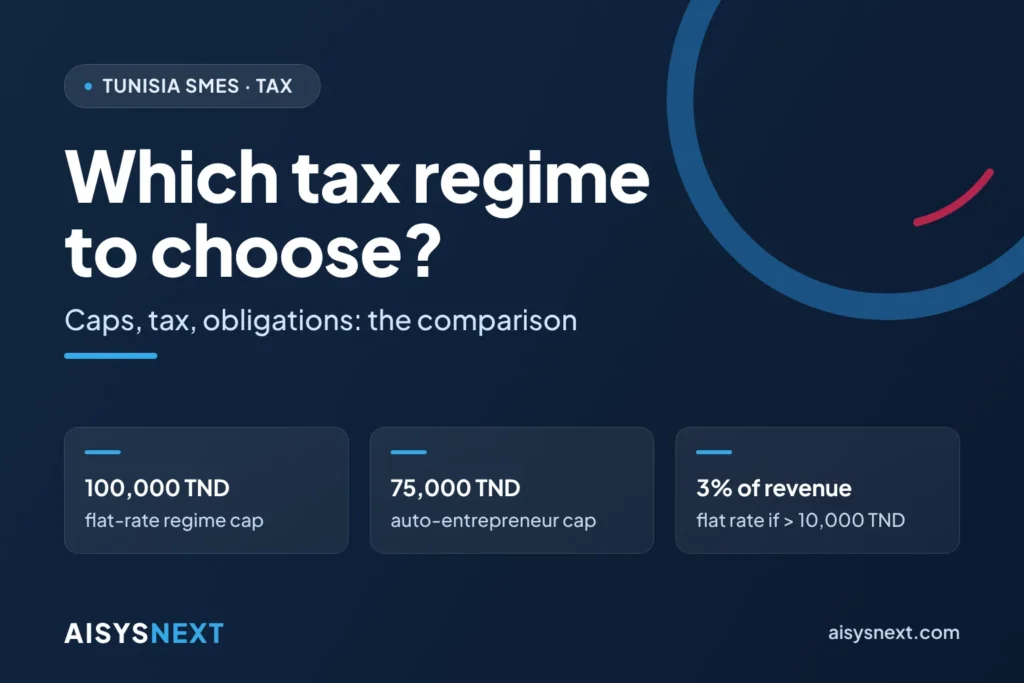
Short answer: The actual-basis regime taxes your profit under the personal income tax (IRPP) scale and requires bookkeeping. The flat-rate regime taxes your revenue, capped at 100,000 TND, at 3% once it exceeds 10,000 TND. The self-employed (auto-entrepreneur) regime, capped at 75,000 TND, pays a single contribution. Choose based on your activity, your projected revenue and your margin.
You launch a shop, a workshop or a service business, and you pick a regime on a neighbor’s advice. At your first tax return, the problem surfaces: cap exceeded, activity excluded from the flat-rate regime, or no bookkeeping in place.
Key points
- Actual-basis regime: IRPP from 0% to 40% on profit (scale for income earned since January 1, 2025), bookkeeping mandatory.
- Standard flat-rate regime: revenue of 100,000 TND at most, a single establishment; 3% of revenue once it exceeds 10,000 TND.
- 2026 optional flat-rate regime: 4,000 TND or 5,000 TND per year; implementing texts not reviewed.
- Auto-entrepreneur: revenue of 75,000 TND at most, 4 years, renewable only once for 3 years.
- Not confirmed: the auto-entrepreneur’s tax share, 200 TND or 100 TND per year, or 0.5% of revenue depending on the version.
Actual-basis regime: who is it for, and how much does it cost?
Under the actual-basis regime, you pay IRPP on your profit and keep accounts that comply with accounting legislation (Article 62 of the Personal Income Tax and Corporate Tax Code). You enter it by choice, or because you do not meet the conditions of the other regimes.
The scale for income earned since January 1, 2025 (Article 44 of the same code, common note (note commune) No. 3/2025) has eight brackets: 0% up to 5,000 TND, 15% up to 10,000, 25% up to 20,000, 30% up to 30,000, 33% up to 40,000, 36% up to 50,000, 38% up to 70,000 TND, and 40% above that.
A sole proprietorship earning industrial and commercial profits (BIC) qualifies for simplified bookkeeping up to 300,000 TND of revenue (buying and reselling, processing, on-site consumption) or 150,000 TND (services). These thresholds come from a version of the code that is not dated 2026: have them confirmed.
Flat-rate regime: what conditions and what rate?
The flat-rate regime under Article 44 bis of the Personal Income Tax and Corporate Tax Code targets a BIC sole proprietorship that runs a single establishment and generates annual revenue of 100,000 TND at most. You cannot use it if:
- you import, sell wholesale, manufacture alcohol-based products or earn commissions (except approved distributors of telecom operators);
- you operate more than one transport vehicle, or a vehicle with a payload of more than 3.5 tonnes;
- you earn non-commercial profits (BNC), fall under the actual-basis VAT regime, or have been reclassified under the actual-basis regime after a tax audit;
- your activity, in a municipal area, appears on the list in Decrees No. 2014-2939 and No. 2022-802.
Up to 10,000 TND of revenue, you pay 400 TND per year in a municipal area and 200 TND elsewhere. From 10,000 to 100,000 TND, you pay 3% of revenue (Article 55 of Decree-Law No. 2022-79). This tax discharges you from IRPP on BIC and from VAT under the actual-basis regime, and it includes the tax on establishments.
The optional flat-rate regime of the 2026 Finance Law
Article 91 of Law No. 2025-17 opens an optional flat-rate regime to individuals earning BIC whose revenue does not exceed 100,000 TND, excluding importers, wholesalers, BNC or brokerage activities, and taxpayers reclassified under the actual-basis regime. The tax amounts to 4,000 TND per year up to 50,000 TND of revenue, 5,000 TND from 50,001 to 100,000 TND, and half those amounts in rural areas. You pay it in two equal installments, before April 25 and before October 25.
Caveat: these amounts come from two consistent commentaries; we have reviewed neither the implementing texts nor the common note. The regime would reportedly target activities excluded from the standard flat-rate regime, such as cafés (excluding tea rooms), and would exempt taxpayers from tax audits for 6 years, with exceptions: have this confirmed before opting in.
Auto-entrepreneur: cap, contribution and obligations
Decree-Law No. 2020-33 of June 10, 2020 reserves this regime for Tunisian individuals who work alone in industry, agriculture, trade, services or crafts, with annual revenue of 75,000 TND at most.
The regime works in practice: the autoentrepreneur.tn platform, launched on November 11, 2024, covers 540 activities and had more than 10,000 registrations as of June 24, 2026, according to the Minister of Employment.
- Duration: 4 years, renewable only once for 3 years (Article 52 of Decree-Law No. 2022-79); card issued within 15 days.
- Social share: contributions under the artisans’ scheme for crafts, first bracket of the self-employed workers’ scheme for other activities; the National Employment Fund covers the first year.
- Obligations: quarterly online revenue declaration, register of receipts and expenses.
- Deregistration: 4 consecutive quarters of unpaid contributions, 5 quarters without declared revenue, exceeding the cap, or more than 90% of revenue earned with a former employer.
Unconfirmed point: the tax share. The text as amended by the 2023 Finance Law provides for 200 TND per year in a municipal area and 100 TND elsewhere, in full discharge of IRPP, VAT and the tax on establishments. In June 2026, the press still cited the 0.5% of revenue set by the original decree-law. The more recent 2023 text should prevail; check the amount on the platform before you commit.
Comparison table: what does each regime cost?
The standard flat-rate regime taxes revenue; the actual-basis regime taxes profit.
| Criterion | Actual-basis regime | Standard flat-rate regime | 2026 optional flat-rate regime | Auto-entrepreneur |
|---|---|---|---|---|
| Revenue cap | None | 100,000 TND | 100,000 TND | 75,000 TND |
| Tax | 0% to 40% of profit | 400 TND or 200 TND, then 3% of revenue | 4,000 TND or 5,000 TND per year | Single contribution, tax share to be confirmed |
| Duration | Unlimited | 6 years, renewable, in a municipal area | Not specified by our sources | 4 years, then 3 years |
| Obligations | Bookkeeping, annual return | Annual return | Two payments per year | Quarterly declaration, register |
Example: a retail shop in a municipal area, assumed eligible for all four regimes, projects 60,000 TND of revenue and 18,000 TND of taxable profit.
- Actual basis: 5,000 × 15% + 8,000 × 25% = 750 + 2,000 = 2,750 TND of IRPP.
- Standard flat rate: 60,000 × 3% = 1,800 TND.
- Optional flat rate: 5,000 TND, in two installments of 2,500 TND.
- Auto-entrepreneur: 200 TND of tax share under the 2023 text, or 60,000 × 0.5% = 300 TND under the other version, plus the social share.
These amounts cover tax only, excluding social contributions and bookkeeping costs. With 12,000 TND of profit, the actual-basis regime drops to 750 + 500 = 1,250 TND, below the flat rate. Outside rural areas, the optional flat-rate regime always costs more than the standard flat-rate regime, which tops out at 3,000 TND for 100,000 TND of revenue.
How do you choose, and which mistakes should you avoid?
Check your eligibility first, then compare costs over several years.
- Check your activity. Importing, wholesale, commissions or BNC income close off the flat-rate regime.
- Project your revenue. Above 75,000 TND, an auto-entrepreneur faces deregistration; above 100,000 TND, the flat-rate regime closes.
- Estimate your margin. A low margin argues for the actual-basis regime, a high margin for a tax based on revenue.
- Plan your exit. An auto-entrepreneur has 7 years at most: track your receipts from day one.
Three mistakes come up again and again: ignoring the list of activities excluded in municipal areas, discovering at year-end that you exceeded the cap, and filing the flat-rate return late. According to a 2018 note, the flat-rate tax rises by 50% beyond 30 days of delay: 1,800 TND becomes 2,700 TND. Add your deadlines to your tax and payroll calendar.
How AISYSNEXT supports you
Your chartered accountant validates the regime; AISYSNEXT works alongside them to organize the figures that inform this choice.
- We scope your needs: invoicing, register of receipts and expenses, tracking of cumulative revenue.
- We configure AROVA ERP (sales, invoicing and accounting, dashboards) to fit the size of your business.
- We develop useful customizations on quote, such as an alert when you approach a cap.
- We train your team and provide support from Tunis.
Present your project in a free quote request or contact our team.
Frequently asked questions
Can you stay under the flat-rate regime indefinitely?
Not in a municipal area: the flat-rate regime lasts 6 years, renewable if you provide the data that proves your eligibility (Article 55 of Decree-Law No. 2022-79). Outside municipal areas, this limit does not apply.
What happens if an auto-entrepreneur exceeds 75,000 TND?
Decree-Law No. 2020-33 lists exceeding the cap among the grounds for deregistration. Track your revenue every quarter and prepare the switch to another regime.
Can a company opt for the flat-rate regime or the auto-entrepreneur regime?
No. These regimes are for individuals. If you set up a company, read our article on the corporate income tax rate and the CSS.
Sources
- Ministry of Employment — Decree-Law No. 2020-33
- Note commune No. 3/2025 — IRPP scale
- Note commune DGELF — flat-rate regime, 2023 Finance Law
- Note commune DGELF — flat-rate regime conditions
- Jurisite Tunisie — Article 62, bookkeeping
- InFirst — 2026 Finance Law, optional flat-rate regime
- Juridoc — 2023 Finance Law, auto-entrepreneur
- Business News — auto-entrepreneur, June 24, 2026
Article up to date as of October 9, 2026. It provides information and does not replace the advice of your chartered accountant or legal counsel.