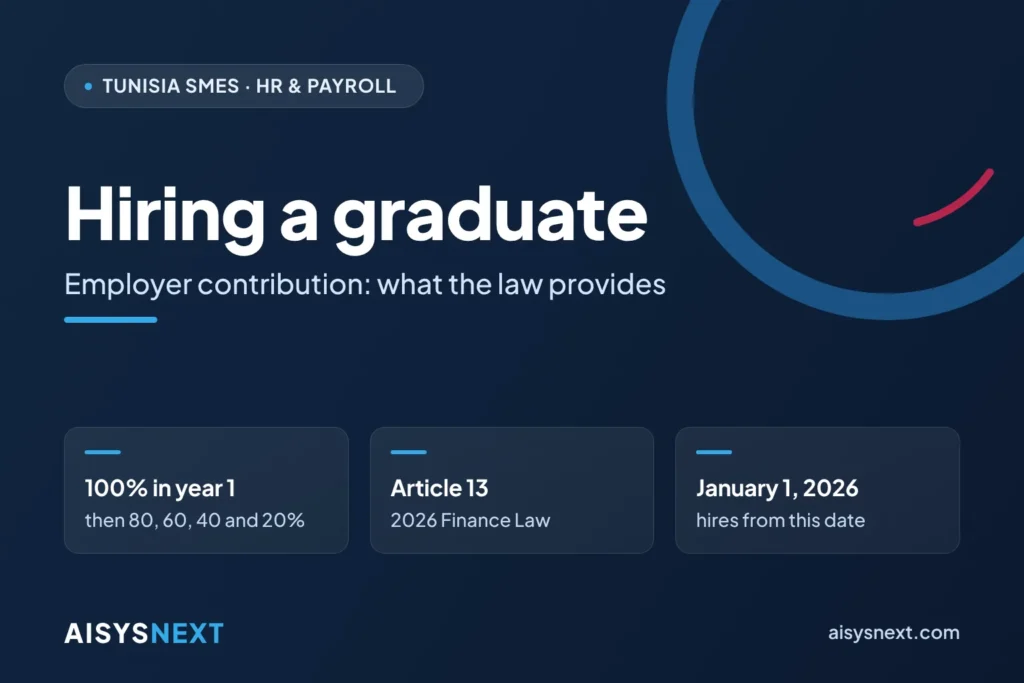
Short answer: Article 13 of the 2026 Finance Law makes the State responsible for the employer’s social security contribution on the salary of higher-education graduates whom private companies hire from January 1, 2026: 100% in the first year, then 80%, 60%, 40% and 20%. Example: for a gross salary of 1,500 TND per month, the State’s share would amount to 9,217.800 TND over five years at the 17.07% rate. As of October 9, 2026, our sources confirm neither an implementing text nor a CNSS (National Social Security Fund) procedure: check before you change your payments.
You hesitate to hire a junior engineer or a business graduate because the full cost of the position exceeds the negotiated gross salary. The law provides relief, but many SMEs are unaware of it. This article separates what the law says from what remains to be confirmed.
Key points
- Legal basis: Article 13 of Law No. 2025-17 of December 12, 2025 (2026 Finance Law).
- Who: private companies that hire a higher-education graduate from January 1, 2026.
- What: the employer contribution to the statutory social security scheme, not the 9.68% employee share.
- How much: 100% in year 1, 80% in year 2, 60% in year 3, 40% in year 4, 20% in year 5.
- Benchmark: overall employer rate of 17.07% since January 1, 2025 (16.57% + 0.5%).
- Not confirmed as of October 9, 2026: the implementing text, the application file to submit, and how to declare the benefit.
What does Article 13 of the 2026 Finance Law provide for hiring a graduate?
The law provides that the State pays all or part of the employer’s social security contribution on your behalf for five years, on a sliding scale. The measure appears in Article 13 of Law No. 2025-17 of December 12, 2025; on December 1, 2025, African Manager reported the vote on it in the ARP (Parliament).
Three conditions emerge from the sources:
- the employer is a private company;
- the employee holds a higher-education degree;
- the hiring takes place on or after January 1, 2026.
In everyday language, people speak of a “CNSS exemption.” The text actually sets up State coverage, limited to the employer contribution: the 9.68% employee contribution does not change.
To put the stakes in context: the basic employer rate stands at 16.57%. Since January 1, 2025, Article 17 of the 2025 Finance Law adds 0.5% for the unemployment insurance fund, for a total of 17.07% on the entire salary. Our article on 2026 CNSS rates and the full cost of an employee details these charges.
How much could you save? Example for a gross salary of 1,500 TND
For a gross salary of 1,500 TND per month, the State’s share would amount to 9,217.800 TND over five years, subject to clarification from the CNSS. The example assumes a constant salary, twelve months of salary per year and the overall employer rate of 17.07%.
The employer contribution comes to 1,500 × 17.07% = 256.050 TND per month, or 3,072.600 TND per year.
| Year of employment | State share | The State pays | You pay |
|---|---|---|---|
| Year 1 | 100% | 3,072.600 TND | 0 TND |
| Year 2 | 80% | 2,458.080 TND | 614.520 TND |
| Year 3 | 60% | 1,843.560 TND | 1,229.040 TND |
| Year 4 | 40% | 1,229.040 TND | 1,843.560 TND |
| Year 5 | 20% | 614.520 TND | 2,458.080 TND |
| Total | 300% | 9,217.800 TND | 6,145.200 TND |
The five rates add up to 300%: the measure equals three full years of employer contributions out of five, or 60% of the cost. Your share rises every year, from 0 TND per month in the first year to 204.840 TND per month in the fifth.
Two caveats on this calculation. Our sources do not specify whether the State coverage includes the 0.5% unemployment insurance fund share. In addition, in its commentary on Article 13, Deloitte cites a reference employer rate of 16.57% for fully exporting companies; its exact scope remains to be checked with the CNSS. At 16.57%, the same example gives 248.550 TND per month and 8,947.800 TND over five years, that is, 270 TND less.
What remains unconfirmed as of October 9, 2026?
The practical procedure remains unconfirmed: we found no implementing text, no standard application file and no code to use in the CNSS return. Five points call for a written answer from the CNSS:
- The formality: prior application, supporting documents, filing deadline.
- The mechanism: a direct reduction of your quarterly payment or another channel.
- How years are counted: from the hiring date or by calendar year.
- The scope: eligible degrees, type of contract, any salary cap.
- Past contributions: what happens to contributions already paid in full for a graduate hired since January 1, 2026.
What comes next also depends on the 2027 Finance Law. As of October 9, 2026, the draft is not public: the government submits it to the ARP no later than October 15, 2026. The official guidelines of August 4, 2026 mention employment of young graduates, with no figure and no payroll measure. We therefore assert neither that the scheme will continue as is nor that it will change.
Which mistakes should you avoid while the procedure remains unclear?
The costliest mistake is to reduce your CNSS payment on your own. Article 105 of Law No. 60-30 applies a penalty of 1% per month of delay, or fraction of a month, to contributions not paid by the due date.
- Budgeting five years with no employer contribution. In the fifth year, you already pay 80% of the contribution.
- Neglecting the return. It remains quarterly and lists employees by name: the graduate appears on it like any other employee.
- Filing the case away without proof. Without a copy of the degree and a verifiable hiring date, you cannot justify anything.
How do you verify and secure the benefit, step by step?
Build your evidence from the day of hiring and get a written answer from the CNSS before making any change.
- Identify the employees concerned. List hires made since January 1, 2026 and gather each person’s degree, contract and hiring date.
- Register them without delay. Our sources cite two deadlines: one month for the CNSS, forty-eight working hours for the workplace accident scheme. To be safe, register the employee within 48 working hours.
- Ask the CNSS in writing. Send the five points above to the competent regional or local office and ask for the reference of the applicable text.
- Have the answer validated. Your chartered accountant confirms the payroll treatment before any reduction.
- Track the sliding scale. Keep a record for each employee: hiring date, year 1 to 5, coverage rate, date of the next rate change.
- Reconcile every quarter. Before the January 15, April 15, July 15 and October 15 deadlines, compare payroll, the quarterly CNSS return and the amount paid.
How AISYSNEXT supports you
AISYSNEXT starts from your hiring and payroll workflow, then equips it with the right tools. Our team works alongside your chartered accountant, without replacing them.
- We audit your recruitment process: employee file documents, returns, deadlines.
- We configure AROVA ERP (personnel files, payroll items) to track, for each employee, the degree, the hiring date and the year on the sliding scale.
- We develop the controls and dashboards you need on a quote basis, for example the projected employer cost over five years.
- We train your administrative team and provide support from Tunis.
Describe your organization in a free quote request or contact our team.
Frequently asked questions
Does the measure apply to a graduate hired before 2026?
No, according to the text: Article 13 covers graduates hired from January 1, 2026. An employee hired in 2025 remains outside the scheme.
Does the State also cover the employee contribution?
No. The measure concerns the employer contribution. You still withhold 9.68% from the graduate’s gross salary, that is, 145.200 TND on a gross salary of 1,500 TND.
Do you need to submit an application to the CNSS to benefit?
We cannot say for certain: our sources describe no application file, no exemption code and no implementing text. Ask your CNSS office in writing and keep its answer.
Sources
- Presidency of the Government — guidelines for the draft 2027 Finance Law
- CNAM — workplace accidents, employee registration
- Jurisite Tunisie — Law No. 60-30, registration and penalties
- Jurisite Tunisie — 2025 Finance Law, Article 17
- Deloitte Société d’Avocats — measures of the 2026 Finance Law
- African Manager — adoption of Article 13
- PwC Tax Summaries — Tunisia, social security contributions
- allAfrica / TAP — draft 2027 State budget
Article up to date as of October 9, 2026. It provides information and does not replace the advice of your chartered accountant or legal counsel.