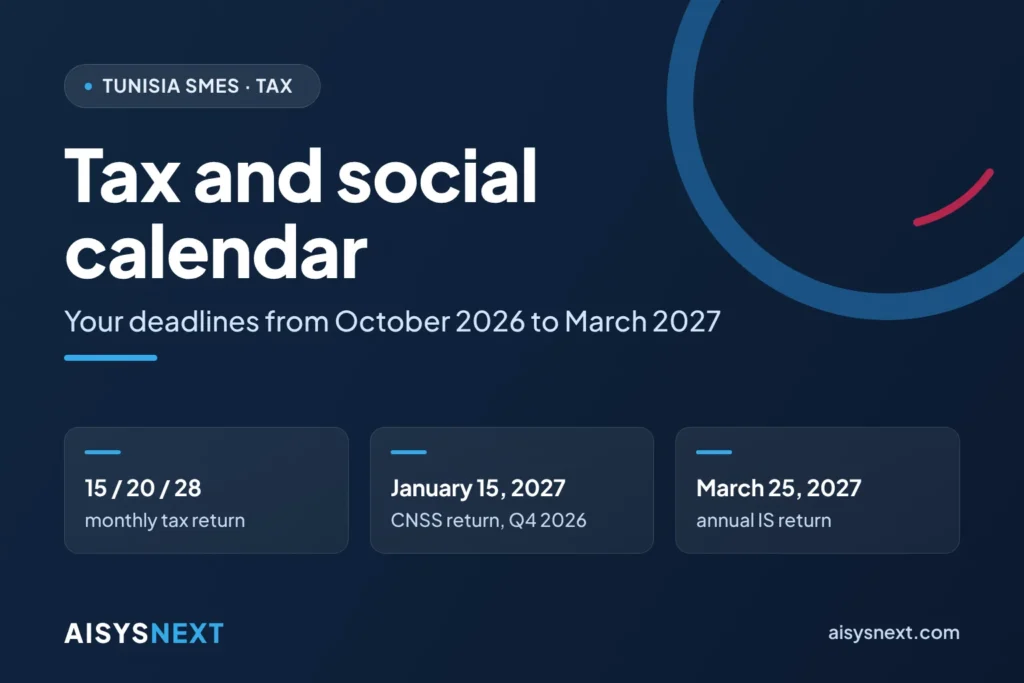
Short answer: From October 21, 2026 to the end of March 2027, your SME files its monthly tax return on the 15th, 20th or 28th depending on its status, then creates its withholding certificates on TEJ (the online tax data exchange platform) before the end of the month. On top of that come the December advance tax installment, the CNSS (National Social Security Fund) return on January 15, 2027 and the annual corporate income tax return on March 25, 2027.
Your accountant watches the 20th of the month, your payroll manager watches January 15, and nobody notes the end of the month for TEJ certificates. The deadlines live in separate calendars; a single oversight costs a penalty.
Key points
- Monthly tax return: on the 15th (individuals), the 20th (companies enrolled in online filing) or the 28th (other companies).
- TEJ certificates: no later than the end of the month following the payment.
- December 28, 2026: 3rd advance tax installment for companies (30%); date to be confirmed for companies that file online.
- January 15, 2027: CNSS return and payment for Q4 2026.
- March 25, 2027: annual corporate income tax (IS) return for fiscal year 2026.
- Late tax filing: 1.25% per month, plus a 3% or 5% fixed penalty.
What are the tax and social deadlines from October 21, 2026 to March 2027?
From October 28, 2026 to March 25, 2027, the table lists them in order. The October dates come from the calendar of the DGI (tax administration); the later ones follow from the statutory rules and remain to be confirmed each month.
| Date | Deadline | Who |
|---|---|---|
| October 28, 2026 | Monthly tax return for September | Companies not subject to online filing |
| October 31, 2026 | TEJ certificates for September payments; end of the statutory annual leave period (Labor Code, Article 117) | Payers; employers |
| November 15, 20 and 28, 2026 | Monthly tax return for October | By status (second table) |
| November 30, 2026 | TEJ certificates for October payments | Payers |
| December 5, 2026 (Saturday) | Annual personal income tax (IRPP) return for employees and retirees (2025 income); check for a postponement | Individuals |
| December 15, 20 and 28, 2026 | Monthly tax return for November | By status |
| December 25, 2026 | 3rd advance tax installment | Individuals under the actual-basis regime |
| December 28, 2026 | 3rd advance tax installment (30%) | Companies; date to be confirmed for online filers |
| December 31, 2026 | Fiscal year-end; TEJ certificates for November payments; end of the 0.5% social solidarity contribution (CSS) on salaries, unless extended | Companies; payers; employers |
| January 1, 2027 | SMIG (guaranteed minimum wage) announced at 582.400 TND (48-hour week scheme) and 493.304 TND (40-hour week scheme), 5% increase under sector-wide collective agreements: amounts to be checked in the JORT (Official Gazette); expected entry into force of the 2027 Finance Law | Employers |
| January 15, 2027 | Quarterly CNSS return and payment, Q4 2026; quarterly return for flat-rate taxpayers | Employers; flat-rate taxpayers |
| January 15, 20 and 28, 2027 | Monthly tax return for December | By status |
| February 15, 20 and 28, 2027 | Monthly tax return for January | By status |
| February 25, 2027 | Annual IRPP return for investment income and property income | Individuals |
| March 15, 20 and 28, 2027 | Monthly tax return for February | By status |
| March 25, 2027 | Annual IS return for fiscal year 2026 (provisional for companies with a statutory auditor) and CSS | Companies |
October 31, 2026 falls on a Saturday: create your certificates by the 30th. For the December installment of companies that file online, no source settles whether the date is the 20th or the 28th: aim for the earlier date.
The 15th, 20th or 28th: when should you file your monthly tax return?
The date depends on your status: within the first 15 days of the month for individuals, the first 20 days for companies enrolled in online filing and online payment (since January 1, 2024, under the 2024 Finance Law), and the first 28 days for other companies.
The return covers withholding tax, VAT, the TCL (local authorities tax), FOPROLOS (housing fund contribution) and the vocational training tax; you file and pay at the same time. Online filing is mandatory under the actual-basis regime from 100,000 TND of gross annual revenue (order of May 22, 2020): at that threshold, your company files on the 20th.
| Filing month | Individuals | Companies filing online | Other companies |
|---|---|---|---|
| November 2026 | 15 (Sunday): probably moved to the 16th | 20 | 28 (Saturday): probably moved to the 30th |
| December 2026 | 15 | 20 (Sunday): probably moved to the 21st | 28 |
| January 2027 | 15 | 20 | 28 |
| February 2027 | 15 | 20 (Saturday): probably moved to the 22nd | 28 (Sunday): probably moved to March 1 |
| March 2027 | 15 | 20 (Saturday, public holiday): probably moved to the 22nd | 28 (Sunday): probably moved to the 29th |
What happens when the deadline falls on a weekend or a public holiday?
It generally shifts to the next business day, but only the DGI’s monthly announcement confirms it. In October 2026, the DGI set the 16th for individuals, since the 15th was a public holiday.
The second table flags seven affected dates between now and March 2027: each postponement remains probable, not certain. Diwan, an unofficial source, states that filing on the following day does not trigger a penalty.
Plan for the last business day before the statutory date and settle your return before 5 p.m.: according to the jibaya.tn online filing guide, the server closes between 5 p.m. and 7 p.m., and settling after 5 p.m. on the due date triggers penalties.
Which oversights cost a penalty?
A late filing that you correct on your own initiative costs 1.25% of the tax per month or part of a month, plus a fixed penalty of 3% up to 60 days late and 5% beyond that (Article 81 of the Code of Tax Rights and Procedures, as amended by Article 59 of Decree-Law No. 2022-79).
Example: you file a return showing 8,000 TND of tax 20 days late. Late-payment interest: 8,000 × 1.25% = 100 TND. Fixed penalty: 8,000 × 3% = 240 TND. Total cost: 340 TND.
Four common oversights:
- mixing up the dates: a company that files online files on the 20th, not the 28th;
- forgetting the end-of-month TEJ certificates;
- leaving the December installment out of the cash flow plan;
- filing the CNSS return late (1% per month under Article 105 of Law No. 60-30; have the CNSS confirm the calculation) or without the salary arrears paid in Q4.
What method keeps you from missing anything?
A single calendar, one owner per deadline and an end-of-month check are enough.
- Identify your column. Individual, company filing online or other company.
- Keep a single calendar. Copy both tables into it, name an owner for each deadline and set alerts 10 days and 3 days ahead.
- Close early. Close the month’s journals before the 10th.
- Read the DGI announcement. At the start of each month, correct any postponed dates.
- Check TEJ at month-end. Verify that “payments of the previous month = certificates issued”; our guide to the TEJ application describes the procedure.
- Plan ahead for December. Set aside funds for the installment, the January CNSS payment and the March IS; update the payroll settings (CSS, SMIG) before the January payroll.
How AISYSNEXT supports you
AISYSNEXT starts from your organization, not from a piece of software, and works alongside your chartered accountant without replacing them.
- We audit your monthly close: who prepares what, and by what date.
- We configure AROVA ERP (invoicing and accounting, purchasing, human resources, dashboards) to bring the data for your returns together in a single database.
- We develop adaptations on a quote basis, for example a deadline schedule with alerts.
- We train your teams and provide support from Tunis.
Describe your organization to us in a free quote request or contact our team.
Frequently asked questions
When should you file the CNSS return for Q4 2026?
On January 15, 2027, together with the payment of contributions. Our article on the quarterly CNSS declaration details the mistakes to avoid.
Can the 2027 Finance Law change this calendar?
Yes. As of October 9, 2026, no text of the draft has been published, and its adoption, expected in December, has no confirmed date. Watch the CSS on salaries, which returns to 1% on January 1, 2027 unless extended, and a possible new phase of e-invoicing for services, for which no text sets a date so far.
Which deadlines come right after March 2027?
For a company, three dates matter: April 30, 2027 (annual employer return, via TEJ), June 25, 2027 (final IS return for companies with a statutory auditor) and July 31, 2027 (filing of financial statements with the RNE, the National Business Register).
Sources
- JIBAYA (DGI portal) — TEJ platform, certificate deadline
- JIBAYA — the 20th deadline for online filers
- JIBAYA — online filing guide
- L’Écho Tunisien — DGI tax calendar, October 2026
- Diwan — tax calendar
- PwC — returns and installments in Tunisia
- La Tribune — late filing penalties
Article up to date as of October 9, 2026. It provides information and does not replace the advice of your chartered accountant or legal counsel.