Introduction
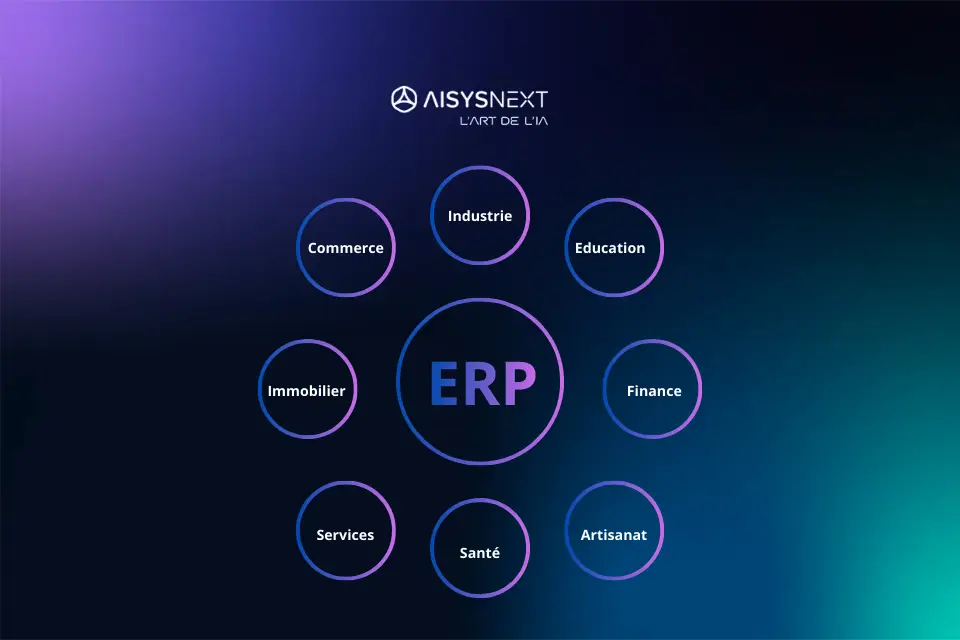
Not all ERP systems are equal… and above all, ERPs differ widely depending on the industry they serve. A retail store, an industrial SME, a B2B services agency, and a training center do not share the same priorities, processes, or constraints.
Yet many companies choose their ERP on generic criteria alone (price, reputation, a few features) without considering their business reality. The result: frustrated teams, underused modules, and needless complexity.
In this article, we walk you through four sectors – retail, manufacturing, services, and education – to show which type of ERP to favor, and how AISYSNEXT helps you find the best-fit solution (Odoo, ERPNext, Dolibarr, or others).
1. Why your industry should guide your ERP choice
An ERP remains an integrated management tool. But depending on your industry, you do not expect the same things from it:
In retail, what matters most is sales, inventory, prices, margins, promotions, and multichannel selling.
In manufacturing, the ERP must above all structure production, planning, quality, and cost prices.
In B2B services, the main challenge is to manage projects, time spent, invoicing, and customer relationships well.
In education and training, the ERP must connect students (or learners), programs, schedules, payments, and assessments.
That is why choosing an ERP by industry is not a luxury, but a condition for the tool to deliver real value.
2. ERP for retail & distribution (stores, wholesalers, e-commerce)
Retail and distribution businesses – physical stores, point-of-sale networks, wholesalers, online retailers – have very specific needs:
Real-time inventory management (multi-warehouse, multi-store)
Point of sale (POS) for fast, simple checkout
Management of prices, discounts, promotions, and catalogs
Connection to e-commerce channels (website, marketplaces)
Margin tracking by product, by product family, and by channel
An ERP suited to retail must therefore offer:
A smooth counter sales / POS module.
Automatic inventory synchronization between stores and warehouses.
Fine-grained pricing management (wholesale prices, promotions, seasonal sales).
Clear reports to monitor inventory turnover and best sellers.
Solutions such as Odoo (POS, e-commerce, inventory) or Dolibarr for small organizations work very well when they are configured properly.
3. ERP for manufacturing & production
Manufacturers and production workshops face different challenges:
Bill of materials (BOM) management
Manufacturing orders and production planning
Tracking of material consumption and production times
Tracking of quality, scrap, and returns
Calculation of cost prices and profitability
An ERP suited to manufacturing must let you:
Manage multi-level bills of materials.
Plan routings, workstations, and capacity.
Track raw materials, work in progress, and finished goods.
Automate the links between sales → production → purchasing.
ERPNext (strongly process-oriented) or Odoo Manufacturing are particularly well suited, provided a specialist in the industrial sector implements them.
4. ERP for B2B services: professional firms, agencies, engineering offices
Service companies need to manage:
Projects with deliverables, milestones, and deadlines
Teams working for several clients
Time spent
Contracts, fixed-price packages, and subscriptions
Billing by time, by fixed price, or by value
An ERP suited to services must provide:
Real project management
Timesheets
A direct project → invoicing link
A sales CRM
Odoo, ERPNext, or Dolibarr for small agencies meet these needs very well if the implementation follows the real business workflow.
5. ERP for education & training centers
Schools, private universities, and training centers have specific needs:
Learner management
Management of programs, modules, and sessions
Scheduling of teachers and rooms
Tracking of attendance, grades, and certificates
Invoicing of tuition fees and professional training
A suitable ERP must let you:
Manage the institution–learner–company relationship
Centralize academic and financial data
Connect to an LMS (Moodle, etc.)
ERPNext (Education) or an Odoo + Moodle pairing are powerful solutions for this sector.
6. How do you choose, in practice, an ERP suited to your industry?
The right method is to:
Map your business processes
Sales, production, training, invoicing, logistics…
Identify your industry’s priorities
Retail → inventory & POS
Manufacturing → production & costs
Services → projects & time spent
Education → learners & tuition
Select the ERP that covers your core business
Odoo, ERPNext, Dolibarr, or another…
Test a complete, real workflow
Order → Delivery → Invoice → Accounting
Work with an integrator who knows your industry
A poorly configured ERP = poor adoption.
7. How AISYSNEXT supports you according to your industry
AISYSNEXT structures its approach by industry, in order to adapt the ERP to your business reality:
Retail & distribution
Odoo (POS, inventory, e-commerce), Dolibarr for small organizations.
Manufacturing & production workshops
ERPNext (manufacturing, process), Odoo Manufacturing.
B2B services
Odoo / ERPNext (Projects, CRM, invoicing), Dolibarr for small agencies.
Education & training
ERPNext (Education) or an ERP + LMS combination.
Our approach
Business assessment
Selection of the most realistic ERP
Phased deployment
Training & support
Conclusion
There is no “perfect ERP for everyone.”
But there is an ERP suited to each industry, each company size, and each ambition.
Retail, manufacturing, services, education: each field has its own priorities and constraints.
A successful ERP project starts from these realities.
With AISYSNEXT, you get industry-specific support and multi-solution expertise to deploy a platform truly aligned with your business.
Do you want to clarify which ERP best matches your industry and your company?
- Talk about your project with an AISYSNEXT expert:
https://aisysnext.com/contact-equipe-expert/ - Get an estimate or a quote for an ERP / CRM project:
https://aisysnext.com/demande-devis-gratuit/