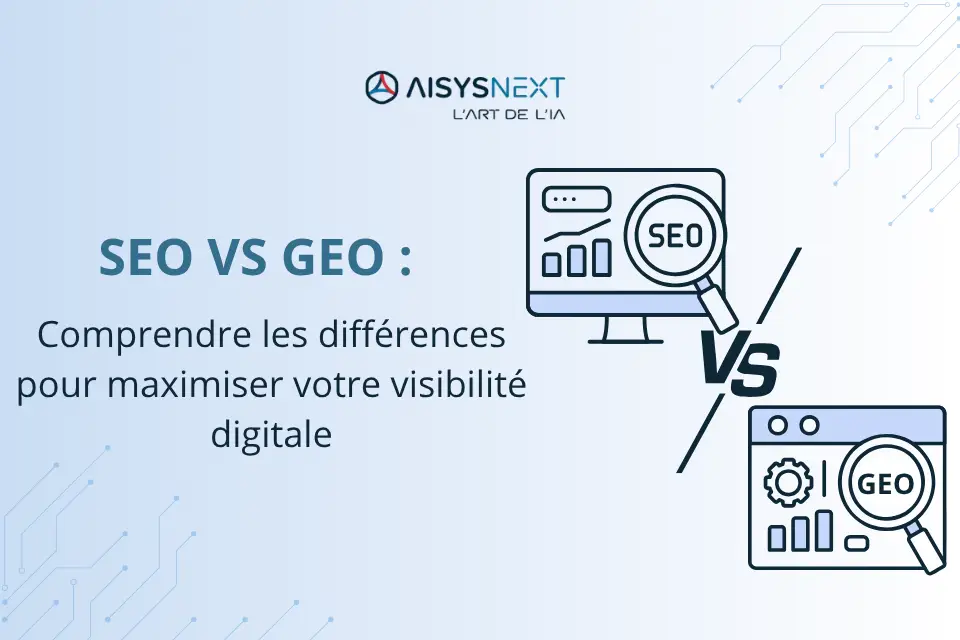
For years, SEO (Search Engine Optimization) has been the pillar of every Google visibility strategy. Today, however, a new discipline is emerging: GEO (Generative Engine Optimization).
Its goal? To make you visible in the answers generated by AI tools such as ChatGPT, Perplexity, Gemini, or Google AIO.
So what is the difference between SEO and GEO, and how do you combine them effectively for complete visibility?
What is SEO?
Definition and goals:
SEO (Search Engine Optimization) aims to optimize a website so that it appears among the top results of traditional search engines such as Google, Bing, or Yahoo.
The main goal is clear: attract qualified traffic and turn visitors into customers.
Key elements of SEO:
Keywords: research the terms your customers use and work them into your content.
Backlinks: earn links from trusted sites to strengthen your authority.
Content quality: write useful, structured, engaging articles.
Technical optimization: speed, mobile compatibility, security, and indexing.
What is GEO?
Definition and goals:
GEO (Generative Engine Optimization) is a more recent approach, born with the rise of generative AI.
Rather than aiming for a ranking on Google, GEO seeks to get your content and your brand recognized in the answers generated directly by conversational AI.
In other words, your goal is no longer only for the user to click through to your site…
It is for your brand to be cited as a reliable source in the answer the AI provides.
Key elements of GEO:
- Clarity: simple, precise language that AI understands easily.
- Structure: headings, lists, and concise points for easy extraction.
- Authority: accurate, reliable content backed by recognized sources.
GEO vs SEO: comparing the approaches
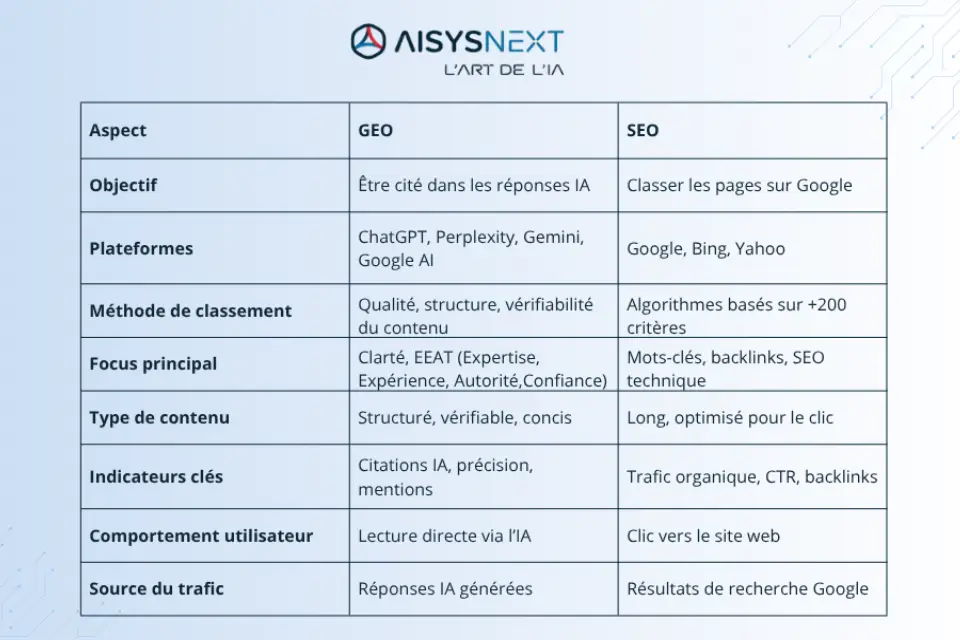
Why combine GEO and SEO?
Many people think GEO will replace SEO, but in reality the two are complementary.
SEO remains essential to attract organic traffic and convert visitors.
GEO, for its part, ensures that your brand is visible in AI answers, even when the user does not visit your site.
By combining these two strategies, you maximize your presence on both traditional search engines and generative AI.
How do you set up an effective GEO + SEO strategy?
1) Create rich, structured content
Use headings (H2/H3), bulleted lists, and FAQs to make reading and extraction easier.
Apply the principles of E-E-A-T: Expertise, Experience, Authoritativeness, and Trustworthiness.
2) Optimize your existing SEO pages for GEO
Add clear, natural sentences that are close to the language AI uses.
Answer direct questions: “How…?”, “Why…?”, “What are the benefits…?”
3) Track your performance on two fronts
SEO tools: Google Search Console, Ahrefs, SEMrush.
GEO tools: Writesonic or Perplexity Tracker to track your AI citations.
The benefits of GEO + SEO
Maximum coverage: traditional search engines + AI
Qualified traffic and better conversion
Stronger brand awareness and authority
Adaptation to users’ new search habits
SEO secures your position in Google results, while GEO guarantees you a presence in AI-generated answers. Together, these two strategies deliver complete visibility, now and in the future, which is essential for any brand that wants to stay competitive.
The AISYSNEXT approach: the synergy of digital performance
At AISYSNEXT, we help companies build 360° visibility:
traditional SEO for Google,
GEO for generative AI,
and integration of web, e-commerce, and CRM solutions to strengthen the entire digital ecosystem.
Our expertise covers:
Web and mobile development
Open-source ERP & CRM (Odoo, Dolibarr, etc.)
Digital marketing & content strategy
Need strategic support with SEO or GEO?
Contact AISYSNEXT today for a personalized audit:
www.aisysnext.com/devis Want to train in the new digital strategies?
Discover our courses on AILEARN:
https://ailearn-academy.com/