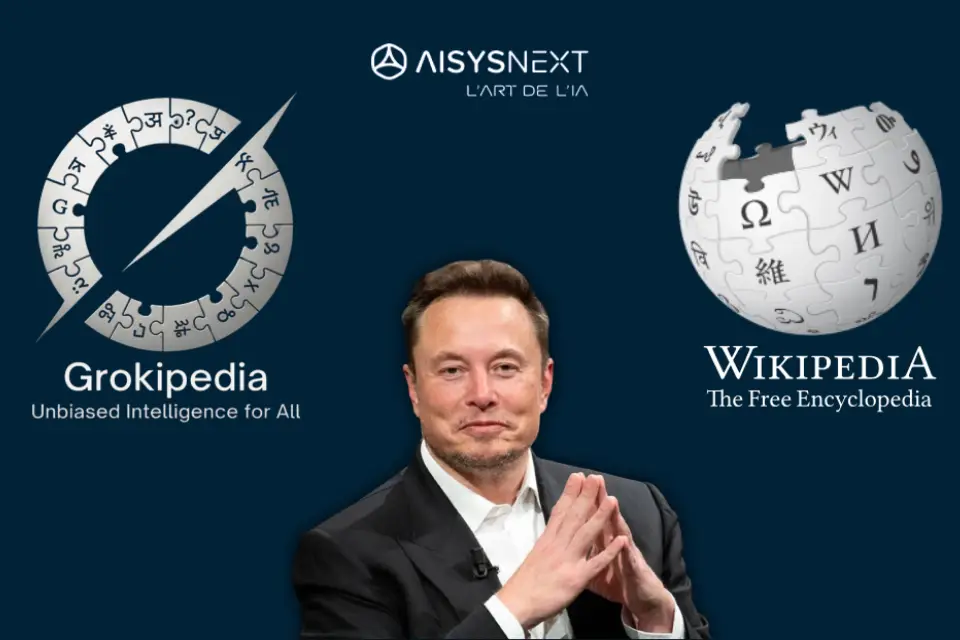
A new battle over online knowledge has begun: Elon Musk has just launched GrokiPedia, an online encyclopedia powered by artificial intelligence and billed as a “more factual” alternative to Wikipedia.
The project, led by xAI, his AI company, promises to “restore the truth” in the face of what Musk describes as the web’s “ideological biases.”
Behind this announcement, however, a new episode is playing out in the duel between technology, information and power.
An AI-generated encyclopedia… but is it really neutral?
GrokiPedia, currently in version 0.1, already gathers nearly 900,000 entries generated by the Grok artificial intelligence, the chatbot developed by Musk.
Unlike Wikipedia — written and verified by a community of volunteers — the content of GrokiPedia is produced automatically by AI from multiple online sources.
The goal of GrokiPedia according to Elon Musk
The billionaire says his goal is simple:
“The truth, the whole truth and nothing but the truth.”
First criticisms and ideological leanings
The page on Elon Musk, for example, highlights his “positive influences” and criticizes “left-leaning” media.
Topics such as Black Lives Matter or progressive journalism are covered from a clearly conservative point of view.
An irony, given that GrokiPedia claims to correct the “biases” it denounces.
Wikipedia: twenty years of contested neutrality
A reliable collaborative model
Since its creation in 2001, Wikipedia has remained one of the web’s leading references, with more than 7 million articles in English and millions of monthly users.
Its founding principle — the neutral point of view — rests on a collaborative, transparent and participatory model.
Neutrality backed by research
Admittedly, critics sometimes accuse it of leaning left or of being influenced by certain ideological currents, but scientific studies tend to show the opposite.
Researchers such as Aileen Oeberst (University of Potsdam) have shown that Wikipedia remains, overall, as reliable and balanced as traditional encyclopedias such as Britannica.
The strength of the community
“Wikipedia’s neutrality was built over time, thanks to communities of volunteers with no conflicts of interest,” notes Capucine-Marin Dubroca-Voisin, former president of Wikimédia France.
The risk of fragmented knowledge
Partisan encyclopedias and information bubbles
The arrival of GrokiPedia is part of a broader trend of digital polarization.
On the right, platforms such as Conservapedia have existed since 2006, while on the left, alternatives such as RationalWiki defend a progressive vision of knowledge.
The dangers of fragmentation
These “partisan encyclopedias” pose a real risk: the creation of information bubbles, where each social group only has access to a truth filtered by its own convictions.
Over time, this could fragment collective knowledge even further and strengthen disinformation, which social media algorithms already amplify.
AI, between engine of progress and carrier of bias
The limits of conversational AI
GrokiPedia is not just an encyclopedia: it is also a learning experiment for AI.
Chatbots and artificial intelligence models train on colossal datasets, and Wikipedia is one of them.
But if these datasets become biased, AI systems will reproduce and amplify those biases.
The domino effect of data
An AI that feeds on slanted content ends up influencing, in turn, how people perceive reality.
Digital ethics researchers are warning about this danger.
“People place almost total trust in conversational AI, whose answers seem credible even when they are wrong,” warns Dubroca-Voisin.
What lesson for the digital world?
For tech and AI enthusiasts
GrokiPedia illustrates the impact of algorithms and AI on how knowledge spreads.
Following these developments helps you understand the limits and opportunities of AI in creating intelligent, contextualized content.
For businesses and digital professionals
The challenge is twofold: guarantee the reliability of the information used in AI projects, and anticipate the evolution of automation and content generation tools.
Conclusion: between knowledge and power, AI is redrawing what we know
With GrokiPedia, Elon Musk is not just competing with Wikipedia.
He is opening a new chapter in the war of artificial intelligences, one in which knowledge becomes a field of political and economic influence.
The question is no longer only who holds information, but who shapes it.
And at a time when AI is becoming a pillar of the modern web, guaranteeing the neutrality of knowledge has never been so vital.