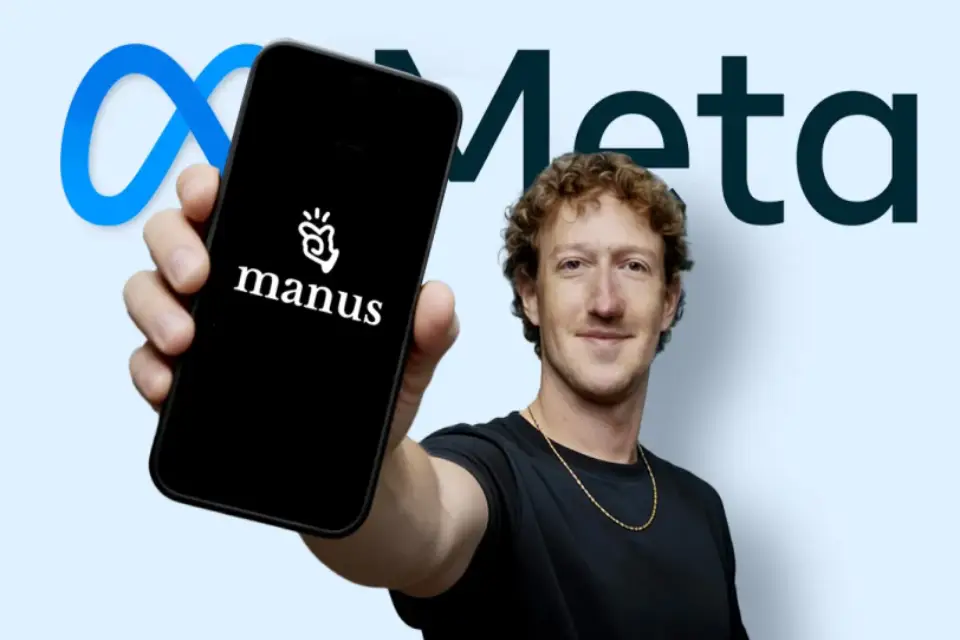
On December 29, 2025, Meta announced the acquisition of Manus, a so-called agentic AI startup — meaning one that can plan and execute complete tasks (research, analysis, production, automation) beyond simple conversation. Meta says it wants to integrate this technology into Meta AI and, more broadly, into its consumer and business products. (Reuters)
Meta + Manus: the key facts to remember
- Acquisition announced on December 29, 2025 (amount not publicly disclosed). (Reuters)
- Several media outlets cite a valuation or order of magnitude of around $2–3 billion, according to sources close to the deal. (Reuters)
- Meta plans to integrate Manus agents into its consumer and business products (including Meta AI). (linkedin.com)
- Manus is expected to keep operating (service maintained) while speeding up its iterations with Meta’s backing. (manus.im)
- Meta says it intends to sever the operational ties in China linked to Manus after the acquisition (a governance and compliance issue). (Business Insider)
What is an “AI agent” — and why is it different from a chatbot?
An AI agent aims to reach a goal: it breaks the task into steps, chooses actions, uses tools (web, files, code, forms, APIs), checks results… and keeps going until the deliverable is ready.
Typical examples:
- preparing a report (collection → analysis → slides → recommendations),
- qualifying leads (questions → scoring → segmentation → follow-up),
- assisting a support team (diagnosis → response → ticket creation → follow-up).
This is precisely the ground on which Manus made its name, with the promise of an agent able to execute complex tasks with little prompting. (Reuters)
Why Meta is making this move now
1) Moving from “AI in the app” to “AI that works in the app”
Meta AI is already present across the Meta ecosystem. The next step is AI that acts: automating micro-processes (replies, sorting, qualification, content generation, optimization) inside Facebook, Instagram and WhatsApp, for both users and businesses. (TechCrunch)
2) Catching up (and pulling ahead) on the “agentic” layer
The market is shifting toward “operational” assistants. By acquiring Manus, Meta is buying a product, a team and a head start on task execution, not just on text generation. (Financial Times)
3) Accelerating adoption through massive distribution
Meta’s advantage is distribution: if the agent is natively integrated, it can quickly reach millions (or even more) of users and businesses. (TechCrunch)
What this could change for businesses (SMEs, e-commerce, services)
Here are the most likely impacts if Meta truly integrates Manus “at the core” of its tools:
1) More autonomous WhatsApp customer service
- contextualized replies,
- intent detection (after-sales service, orders, appointments),
- ticket creation,
- automatic follow-ups.
2) Lead qualification & nurturing on Instagram and Facebook
An agent can:
- ask the right questions in DMs,
- score a lead,
- route it to a sales rep,
- trigger a sequence (message, email, reminder).
3) Smarter marketing reporting (ads + content)
Collect the data, explain the variations, suggest optimizations (creative, audience, budget), then generate a readable report.
4) “Process-assisted” content production
Not just “write a post,” but:
brief → angle → variants → tone validation → scheduling → multi-format adaptation.
5) Operational automation (catalogs, product pages, pricing)
For e-commerce: updating product pages, SEO enrichment, consistency checks, attribute generation… with human validation.
Important: Meta has not yet detailed which modules will arrive where and when. At this stage, this is a confirmed strategic direction, not a fully documented product rollout. (Reuters)
Points to watch (and to take seriously)
Data & privacy
Meta states in particular that new employees will not have access to the historical data of Manus customers, and it emphasizes security and data-separation measures. (Business Insider)
For a business, the rule stays the same: never connect an agent to sensitive data without governance.
Quality, errors and “trust”
An agent can act fast… and get things wrong fast. You need:
- guardrails,
- validations,
- logs,
- limits on actions (especially if the agent can “execute”).
Platform dependency
If the agent becomes “native” in Meta, some businesses risk building processes that depend too heavily on the ecosystem (WhatsApp/IG). Plan ahead for portability, CRM and export.
How to prepare now (without waiting for product announcements)
- List 10 repetitive tasks (support, sales, marketing, admin).
- Turn them into SOPs (step-by-step checklists).
- Identify the data required (FAQs, products, terms, stock levels, prices, after-sales policies…).
- Structure a knowledge base (Notion / Drive / ERP / CRM) with update rules.
- Define a framework:
- what the agent is allowed to do,
- what it must submit for validation,
- which KPIs to track (resolution rate, response time, satisfaction, conversion).
This structuring work is what makes the difference between “gimmick AI” and “AI that delivers.”
FAQ
Will Manus disappear into Meta?
At this stage, communications point instead to service continuity for Manus, with gradual integration of its technologies into Meta. (Business Insider)
Why is there so much talk about its ties to China?
Because its origins and some past operations raised governance questions. Meta says it intends to sever the operational ties in China linked to Manus. (Business Insider)
Will this affect Meta Ads right away?
Probably not “overnight.” Above all, the acquisition sets a trajectory: toward more autonomous tools for creation, optimization, reporting and the lead-to-sale journey. (TechCrunch)
Conclusion
The Manus acquisition is not just one more “startup” news item: it is a clear signal that 2026 will be less the year of chatbots… and more the year of AI agents integrated into workflows, able to execute, automate and produce deliverables.