Introduction
A well-chosen, well-deployed ERP can transform an SME: fewer errors, more visibility, smooth processes… but the reverse is also true. A poorly prepared ERP project can cause delays, cost overruns, and a great deal of frustration.
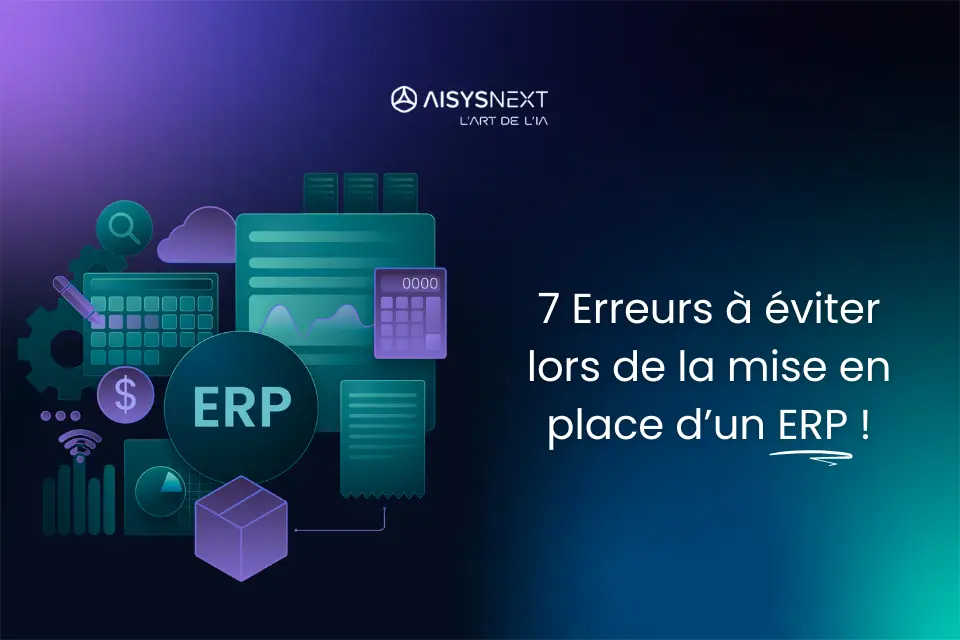
In this article, we review 7 common mistakes made when implementing an ERP, observed in the field with SMEs and startups, and above all how to avoid them with a structured, realistic approach.
1. Focusing only on the software… and forgetting the business
Many companies start their project with this question:
“Which ERP should we choose? Odoo, ERPNext, Dolibarr, or another?”
It is a good question, but it is not the first one to ask.
The first is: “What are my real business needs, today and in 2 years?”
Mistake no. 1: starting from the software instead of the business processes
The result: you configure the ERP to fit the tool, not the company.
How do you avoid it?
Map your current processes (sales, purchasing, inventory, invoicing…)
Identify bottlenecks, redundancies, and risks.
Define what you want to improve (time saved, fewer errors, visibility…).
At AISYSNEXT, every ERP project starts with this business assessment, before we even talk about modules.
2. Trying to deploy everything at once
The second typical mistake: trying to integrate everything in one go.
Sales, purchasing, inventory, accounting, CRM, projects, production, HR, e-commerce… in a single phase.
Mistake no. 2: aiming for a “big bang” that paralyzes the company
How do you avoid it?
Start with a core scope: sales, invoicing, inventory, accounting.
Plan the additional modules in a phased roadmap.
Test and stabilize each phase before adding another.
An ERP is a lever for transformation: move forward step by step.
3. Underestimating the importance of data (quality and migration)
An ERP relies on a single database.
Inconsistent information = a problem factory.
Mistake no. 3: neglecting data quality and migration
How do you avoid it?
Clean up customers, items, price lists, and stock before the migration.
Remove duplicates and harmonize formats.
Test the migration in pre-production before the real one.
AISYSNEXT helps its clients start from a sound foundation.
4. Not involving users from the start
An ERP is not intended for management alone. The teams use it every day.
Mistake no. 4: deciding in a small committee without including key users
How do you avoid it?
Identify lead users in each department.
Involve them in the scoping workshops.
Have them take part in testing and validation.
The more involved the teams are, the more natural adoption becomes.
5. Underestimating training and support
Installing an ERP ≠ getting people to adopt it.
Believing that “everyone will figure it out by clicking around” is a mistake.
Mistake no. 5: reducing training to a simple demonstration
How do you avoid it?
Plan training tailored to each profile.
Provide simple materials: guides, videos, checklists.
Offer close support after go-live.
At AISYSNEXT, training is a central step.
6. Not defining indicators to measure success
An ERP is an investment. Without indicators, you cannot measure its return.
Mistake no. 6: not clearly defining the objectives of the ERP
How do you avoid it?
Set measurable objectives:
Reduce order processing time.
Cut invoicing errors.
Get real-time visibility into inventory.
Produce reliable reporting in a few clicks.
An ERP must generate visible, quantifiable gains.
7. Choosing the wrong partner… or doing it alone
Many people think an ERP project = a technical installation.
That is wrong: it is a transformation project.
Mistake no. 7: working with an unsuitable provider or doing everything in-house
How do you avoid it?
Choose a partner who masters the solutions AND the realities on the ground.
Check methodology, references, and capacity to support you.
Demand a transparent approach: scope, schedule, budget, risks.
AISYSNEXT: safeguarding your ERP project from start to finish
At AISYSNEXT, our mission is to safeguard your ERP project:
Analysis of your processes and challenges.
Recommendation of the right solution (Odoo, ERPNext, Dolibarr…).
Gradual, controlled deployment.
Data migration, training, and support.
Ongoing monitoring and optimization.
By avoiding these 7 mistakes, you turn your ERP into a real performance lever for your SME.
Need support?
Talk about your project with an expert:
https://aisysnext.com/contact-equipe-expert/
Get an ERP/CRM estimate or quote:
https://aisysnext.com/demande-devis-gratuit/