Running a business quickly becomes complex as activity grows: more customers, more transactions, inventory management, accounting obligations, cash flow monitoring, team coordination…
Without a structuring tool, this complexity holds back performance and weakens growth.
An ERP (Enterprise Resource Planning) is designed to address exactly these challenges.
It centralizes the company’s key processes in a single, reliable, and scalable platform.
Below, in the form of a practical guide, you will find the 10 major benefits of an ERP, along with the concrete risks of not implementing an ERP.
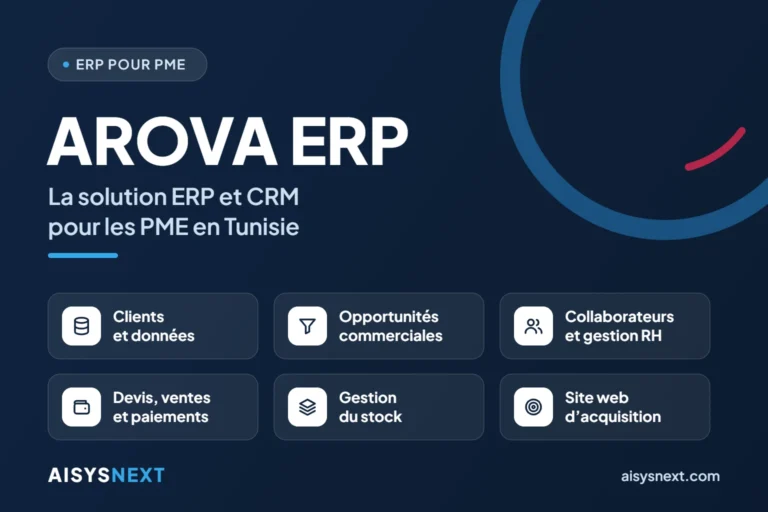
Centralize all company data
An ERP brings all strategic information together in a single system:
sales, invoicing, accounting, purchasing, inventory, human resources, and customer relations.
This centralization eliminates information silos and sharply reduces the errors caused by duplicate entry or scattered files.
The company relies on a single, reliable source of data.
Steer the business with a clear, real-time view
With built-in dashboards and indicators, an ERP gives an instant view of performance:
revenue, margins, cash flow, unpaid invoices, sales performance.
The executive can follow how the business is doing without waiting for manual reports that are often incomplete or outdated.
Decision-making becomes fast, fact-based, and controlled.
Secure financial management and cash flow
Cash flow remains one of the most sensitive issues for businesses, especially SMEs.
An ERP lets you track financial flows precisely, anticipate cash requirements, and limit late payments.
This visibility reduces financial risk and strengthens the company’s stability.
The ERP becomes a tool for preventing cash flow strain.
Automate processes and boost productivity
Invoicing, customer reminders, payment tracking, inventory management, reporting…
An ERP automates repetitive, low-value tasks.
Teams save time, human errors decrease, and overall productivity improves.
The company runs more smoothly and more efficiently.
Structure the company’s growth
When a company grows without a suitable structure, organizational problems appear quickly.
An ERP lets you put solid processes in place that can absorb growth without disorganization.
It supports a rising volume of activity without multiplying tools or complicating management.
Growth becomes scalable and controlled.
Optimize inventory and purchasing management
Poor inventory management leads to extra costs, losses, and tied-up cash.
An ERP lets you track stock levels in real time, optimize replenishment, and improve supplier relationships.
This control contributes directly to better profitability.
Less waste, more control.
Strengthen compliance and traceability
Accounting, tax, and regulatory obligations require structured, traceable data.
An ERP lets you keep a history of operations, simplify audits, and secure compliance.
This traceability strengthens the company’s credibility with government agencies, auditors, and partners.
The ERP becomes a compliance ally.
Improve collaboration between teams
With an ERP, all departments work on the same platform and share the same information.
Exchanges flow smoothly, communication errors decrease, and coordination improves.
The company gains consistency and collective efficiency.
Prepare the company for digital transformation
A modern ERP is an essential foundation for integrating:
e-commerce, advanced automation, banking tools, artificial intelligence, and predictive reporting.
Without an ERP, digital transformation remains partial and limited.
An ERP is a digital foundation, not just management software.
Build credibility with partners and investors
A company structured around an ERP inspires confidence:
reliable data, clear processes, a firm grip on its finances.
Banks, investors, and large customers favor companies that can demonstrate professional management.
The ERP becomes a competitive advantage.
The drawbacks of not implementing an ERP
Not launching an ERP project carries significant risks:
- loss of visibility over the business
- excessive dependence on Excel and on key people
- recurring operational errors
- difficulty keeping up with growth
- hidden costs caused by a lack of organization
In the long run, these limits hold back the company’s performance and competitiveness.
Conclusion
An ERP is not reserved for large organizations.
For SMEs and businesses in Africa, it is a major strategic lever for structuring operations, securing management, and supporting sustainable growth.
At AISYSNEXT, we support companies in the gradual implementation of ERPs suited to their reality, with a pragmatic, scalable, results-oriented approach.